
Connect with us


.png)

Schedule a Consultation!
Where Should Estrogen Cream Be Applied?
Physician-reviewed women’s hormone guide
You finally have the prescription in your hand, you get home, and then realize nobody really answered one surprisingly basic question:
Where exactly am I supposed to put this cream?
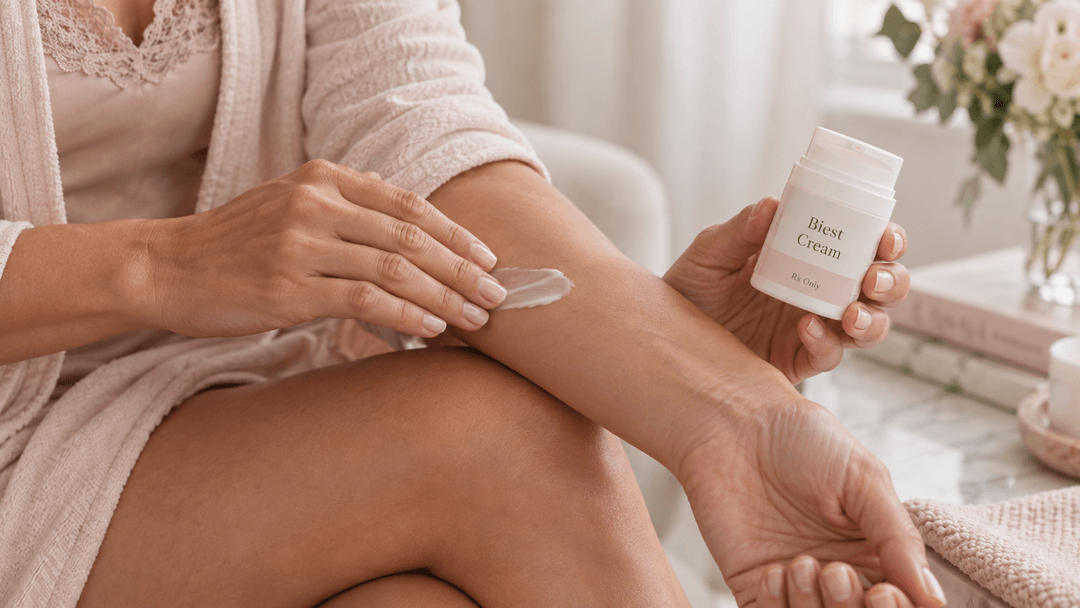
Your inner thigh? Your arm? Your abdomen? And if your prescription says Biest, is that applied the same way as the estrogen cream you’ve heard other women talk about using vaginally?
These are good questions because not every estrogen cream is used the same way.
The correct application site depends on the exact estrogen product, formulation, concentration, and reason it was prescribed. A compounded transdermal estrogen or Biest cream designed to absorb through your skin is very different from prescription vaginal estrogen cream.

The Short Answer: Where Should Estrogen Cream Be Applied?
Estrogen cream should be applied only to the location recommended for your exact prescription.
There is no single body site that is correct for every estrogen cream.
For example, an FDA-approved transdermal estradiol gel such as Divigel is applied to the upper thigh and the patient alternates between the left and right thigh. Other estrogen products may have different approved application sites.
Compounded estrogen and Biest creams are different. Because these preparations can vary in their ingredients, concentration, cream base, and prescribed dose, there is no universal application site that applies to every compounded prescription. ACOG notes that compounded menopausal hormone preparations are individually prepared and are not reviewed by the FDA for safety, effectiveness, or quality in the same manner as FDA-approved medications.
And vaginal estrogen cream is a different type of treatment altogether. Estradiol vaginal cream is specifically designed to be placed in the vagina according to the product instructions, commonly with a supplied applicator.
The most important takeaway is simple:
Do not assume that instructions for another woman’s estrogen cream—or instructions you found online—apply to your prescription.
First, What Kind of Estrogen Cream Do You Have?
Before worrying about which part of your body to use, look at what was actually prescribed.
There are two very different situations that women commonly mean when they say “estrogen cream.”
Systemic transdermal estrogen
A systemic transdermal hormone is placed on the skin so that the medication can be absorbed and circulate through the body.
Depending on the prescription, this category can include:
- FDA-approved estradiol gels
- compounded estradiol creams
- compounded estrogen combinations
- compounded Biest preparations
These therapies may be prescribed as part of a broader menopause or hormone-replacement plan.
Vaginal estrogen cream
Vaginal estrogen is generally prescribed for symptoms involving the vagina and urinary tract, such as vaginal dryness or discomfort associated with menopause.
Prescription estradiol vaginal cream is placed in the vagina according to its specific instructions rather than being used like a systemic transdermal hormone cream.
This distinction matters.
Systemic estrogen and vaginal estrogen are not interchangeable simply because both products happen to contain estrogen and come in a cream or gel.
NovaGenix discusses these differences in more detail in our guide to Estrogen Therapy for Women.
Where Can Transdermal Estrogen Be Applied?
This is where online advice can become confusing.
You may see women recommending the inner thighs, wrists, arms, abdomen, or other areas. But the safest answer is not to choose an application site based on a social-media post or someone else’s prescription.
Application sites can be formulation-specific.
Approved medications are studied using particular application locations, and compounded preparations may come with instructions based on the formulation prescribed for you.
Let’s look at some of the locations women ask about most often.
Can You Apply Estrogen Cream to the Inner Thigh?
Possibly—but not simply because the inner thigh is commonly mentioned online.
Some transdermal estradiol products use the thigh as their designated application area. Divigel, for example, is labeled for application to either the left or right upper thigh, with patients alternating thighs from day to day.
That does not mean every estradiol cream, Biest cream, or compounded hormone preparation should automatically be used on the inner thigh.
If your prescription says thigh, follow the instructions provided with that specific medication.
If it doesn’t, ask before changing where you apply it.
Can Estrogen Cream Be Applied to the Abdomen?
Some topical hormone products may use abdominal skin, while others specifically designate different areas.
That is why it’s important not to generalize instructions from one hormone product to another.
If your compounded prescription instructs you to apply the cream to the abdomen, follow those directions. But don’t move an estrogen medication to the abdomen simply because another topical hormone you’ve used in the past was applied there.
The prescribed site is part of the treatment instructions.
Can Estrogen Cream Be Applied to the Arms?
Again, it depends on the formulation.
Some transdermal hormone products use the upper arms, but that doesn’t make the arms a universal application site for estrogen.
If your medication label or prescribing clinician specifies the arm, follow those instructions. Otherwise, don’t change locations without asking.
This is particularly important with compounded hormone creams because one woman’s prescription may differ substantially from another woman’s in both dose and formulation.
Can You Put Estrogen Cream on Your Breasts?
You should not assume the breasts are an appropriate application site.
For example, the prescribing information for Divigel specifically says not to apply the medication to the breasts, face, irritated skin, or in or around the vagina.
Unless your specific prescription explicitly directs otherwise, don’t choose the breast as an estrogen application site on your own.
Where Should Biest Cream Be Applied?
This is one of the most common questions we hear because Biest isn’t one standardized commercial product.
Biest generally refers to a compounded estrogen preparation containing a combination of estrogens, commonly estradiol and estriol.
Because it is compounded, the:
- hormone concentrations
- proportions of hormones
- cream base
- prescribed amount
- dosing schedule
- intended application site
can differ from one prescription to another.
ACOG recommends FDA-approved menopausal hormone therapies when an appropriate approved option exists and advises patients using compounded bioidentical hormone therapy to understand that these preparations do not undergo the same FDA review for safety, effectiveness, and quality.
The FDA also notes that there are currently no FDA-approved drugs containing estriol.
So if your prescription says Biest, there isn’t one internet answer that applies to every woman.
Follow the application location written on your prescription and provided by your clinician or compounding pharmacy.
And if those directions aren’t clear, ask before changing sites.
Should I Rotate Where I Apply Estrogen Cream?
Sometimes.
Again, the important distinction is between a specific product instruction and a universal rule.
Divigel instructs patients to alternate between the left and right upper thigh each day, which can also help reduce repeated irritation to one area of skin.
A different transdermal product or compounded estrogen cream may have different instructions.
So rather than automatically rotating among your thighs, arms, and abdomen, follow the site-rotation instructions for your medication.
Should You Rub Estrogen Cream All the Way In?
This depends on what you’re using.
With Divigel, for example, the instructions call for gently spreading the medication in a thin layer over the designated area. Vigorous rubbing or massaging isn’t necessary.
A compounded cream may have different directions depending on the vehicle used by the pharmacy.
This is another reason seemingly simple advice like “rub it in until it’s gone” shouldn’t automatically be applied to every estrogen product.
How Long Should Estrogen Cream Dry Before Getting Dressed?
Let the medication dry according to the instructions for your prescription before covering the area with clothing.
For Divigel, the application site should be allowed to dry completely before getting dressed.
With compounded creams, drying time can depend on the particular cream base and amount being applied.
If you’re finding that the medication remains wet or greasy for an unusually long time, don’t simply start applying less. Ask your prescribing clinician or pharmacy whether your technique is correct.
How Long After Applying Estrogen Can You Shower or Swim?
There isn’t one waiting period for every estrogen product.
For an approved transdermal medication, follow the product instructions exactly. Washing the area too soon may affect the amount of medication available for absorption.
For compounded creams, use the directions provided with your prescription.
A good rule here is:
Don’t borrow showering instructions from another estrogen product simply because both are applied to the skin.
Can Estrogen Cream Transfer to Your Husband or Partner?
Potential transfer is another reason application technique matters.
After using a topical hormone, follow the product’s instructions regarding:
- handwashing
- drying time
- covering the application area
- bathing
- skin-to-skin contact
Divigel’s instructions, for example, include washing the hands after application and allowing the treated area to dry before dressing.
This becomes especially relevant if the treated area could come into direct contact with a partner, child, or other household member.
Wash your hands after handling topical estrogen unless your specific instructions say otherwise, and don’t allow someone else to touch a freshly treated area.
If you think another person has accidentally had significant contact with your hormone medication, contact your pharmacist or healthcare provider for guidance.
What If My Cream Contains Estrogen, Progesterone, and Testosterone?
Compounded hormone prescriptions can sometimes include more than one hormone in the same preparation.
That does not mean the cream should automatically be applied according to directions for estrogen alone, testosterone alone, or progesterone alone.
A combination preparation can have its own:
- concentration
- amount per dose
- base
- application instructions
- dosing schedule
Follow the instructions for the combination product you were actually prescribed.
Don’t switch application sites because you’ve read that testosterone absorbs well in one location or estrogen is commonly used somewhere else.
For background on testosterone in women, see our guide to testosterone therapy for women. Our separate guide to where to apply testosterone cream and gel explains why application sites for testosterone products are also product-specific.
Is Vaginal Estrogen Cream the Same as Estrogen Cream Used on the Skin?
No.
This is probably the single most important distinction in this entire article.
Prescription estradiol vaginal cream is intended to be placed in the vagina according to its dosing instructions. Current product labeling describes measuring the prescribed dose into the supplied applicator and inserting the medication vaginally.
A systemic transdermal estrogen product is instead designed for absorption through designated areas of skin.
Systemic transdermal estrogen
Where it goes
Applied to designated skin sites
Purpose
Intended to provide transdermal hormone exposure
Application site
Varies by product
Typical role
May be part of systemic menopause therapy
Vaginal estrogen cream
Where it goes
Administered vaginally according to the product directions
Purpose
Commonly used for vaginal and genitourinary menopausal symptoms
Application site
Uses vaginal administration
Typical role
Often used when local treatment is the goal
If you’ve been prescribed estrogen cream and aren’t sure which type you have, check the label before applying it.
Does It Matter Where You Apply Estrogen Cream?
It can.
Application location isn’t merely a matter of convenience.
Transdermal products are developed and studied using particular application areas. Changing the location may change how the medication behaves, which is one reason product instructions specify where the medication should be used.
That’s also why we don’t recommend moving your estrogen cream to another area simply because you’ve heard that the skin there “absorbs hormones better.”
More absorption isn’t automatically better.
The goal of hormone therapy isn’t to absorb as much estrogen as possible. The goal is to use an appropriate dose and delivery method for the individual woman being treated.
What If My Estrogen Cream Doesn’t Seem to Be Working?
It’s frustrating when you’ve started hormone therapy and don’t feel the improvement you expected.
But before assuming the problem is where you’re putting the cream, several things deserve consideration:
- Are you using the amount prescribed?
- Are you applying it consistently?
- Are you following the correct application instructions?
- How long have you been using it?
- Is the formulation appropriate for the symptoms being treated?
- Is the dose appropriate?
- Could something else be contributing to the symptoms?
Hormone treatment should ultimately be evaluated by more than one number on a lab report.
Symptoms, response to treatment, side effects, health history, and appropriate monitoring all matter.
Don’t respond to a disappointing result by applying extra cream or moving it to a new body site in an attempt to absorb more estrogen.
Talk with your clinician first.
Do Women Taking Estrogen Need Progesterone Too?
For women with an intact uterus who use systemic estrogen, an appropriate progestogen is generally used to protect the uterine lining.
Unopposed systemic estrogen can increase the risk of endometrial cancer, while adding a progestogen reduces that risk.
That doesn’t mean every woman using every form of estrogen follows exactly the same regimen.
The need for progesterone depends on factors including whether you have a uterus and the type of estrogen therapy you’re using.
NovaGenix explains this more fully in our guide to Progesterone Therapy for Women.
Estrogen Cream vs. Estrogen Patch: Is One Easier?
For some women, yes.
Both topical estrogen and an estrogen patch can deliver estradiol through the skin, but the day-to-day experience is different.
A cream or gel requires you to:
- measure or dispense the prescribed amount
- apply it correctly
- use the designated body site
- allow it to dry
- consider skin-to-skin transfer
A patch removes some of those daily application steps but brings its own practical considerations, including skin adhesion and irritation.
The “better” option isn’t automatically the same for every woman.
Your symptoms, preferences, health history, uterus status, risk factors, previous experience with hormone therapy, and treatment goals all matter.
Learn more in our Estrogen Therapy for Women guide.
When Should You Call Your Healthcare Provider?
Ask for help if:
- you aren’t sure where your prescription should be applied
- the pharmacy instructions and clinician instructions appear different
- you’re experiencing significant skin irritation
- you’re considering changing your application site
- the medication doesn’t appear to be working as expected
- you’ve had unexpected vaginal bleeding
- you’re unsure whether your product is vaginal or transdermal
- you believe someone else may have been exposed to your medication
Don’t increase the amount or change the application technique on your own.
And symptoms such as chest pain, sudden shortness of breath, sudden weakness, severe headache, or sudden vision changes warrant prompt medical evaluation.
Frequently Asked Questions About Estrogen Cream
Where is the best place to apply estrogen cream?
There is no universal “best” location. The correct site depends on the specific estrogen product or compounded prescription you were given. Use the application area listed on your medication instructions.
Where should Biest cream be applied?
Biest is compounded rather than one standardized FDA-approved product, so application instructions can vary. Follow the directions provided by your prescribing clinician and compounding pharmacy rather than another patient’s instructions.
Can I put estrogen cream on my inner thighs?
Some transdermal estradiol products are applied to the upper thigh, but that doesn’t mean every estrogen or Biest cream belongs on the inner thigh. Check your specific prescription.
Can estrogen cream be applied to the abdomen?
Only if the instructions for your specific product or compounded prescription designate the abdomen as an appropriate application area.
Can estrogen cream be applied to my arms?
Some transdermal hormone preparations use the arms, but this isn’t a universal estrogen application site. Follow the directions for the medication you’ve actually been prescribed.
Can I apply estrogen cream to my breasts?
Don’t assume the breasts are an appropriate application site. Some approved estradiol products specifically state that they should not be applied to the breasts.
Should I alternate estrogen cream application sites?
Some products instruct patients to alternate sites. Divigel, for example, alternates between the left and right upper thigh. Other medications may have different instructions.
How long after applying estrogen cream can I shower?
The waiting period depends on the specific formulation. Follow the instructions supplied with your prescription rather than assuming all topical estrogen products have the same waiting period.
Can estrogen cream transfer to my partner?
Topical hormone medication can remain on the application area for a period after use, so follow the medication’s handwashing, drying, covering, and skin-contact instructions carefully.
Is vaginal estrogen cream the same as transdermal estrogen cream?
No. Prescription vaginal estrogen cream is administered vaginally according to its specific dosing instructions, while systemic transdermal estrogen is applied to designated areas of skin.
One Prescription Doesn’t Fit Every Woman
If you’ve spent ten minutes online trying to figure out where other women put their estrogen cream, you’ve probably discovered something frustrating:
Everyone seems to have a different answer.
That’s partly because they may actually be using different medications.
One woman may have an FDA-approved estradiol gel.
Another may have vaginal estradiol cream.
Someone else may have a compounded Biest prescription.
And another woman may be using a compounded preparation containing several hormones.
Those treatments shouldn’t automatically share the same application instructions.
The better question isn’t:
“Where does everyone put estrogen cream?”
It’s:
“Where should I apply the exact estrogen prescription I was given?”
That’s the question your medication instructions, pharmacist, and treating clinician should answer clearly.
Have Questions About Estrogen Therapy?
Perimenopause and menopause can affect sleep, temperature regulation, vaginal comfort, sexual health, mood, and how you feel in your own body.
Hormone therapy can be appropriate for some women, but choosing the right treatment involves much more than simply prescribing estrogen.
At NovaGenix Health & Wellness, women receive physician-led hormone evaluations that consider symptoms, medical history, treatment goals, screening, medication options, and ongoing response to treatment.
If hormone therapy is appropriate, your treatment plan should include something that often gets overlooked:
clear instructions about exactly how to use it.
Looking for more? Browse the NovaGenix Patient Education Library for guides on women’s hormones, testing, and treatment options.
Medical Sources
- DailyMed: Divigel (estradiol gel) 0.1% — prescribing information and patient instructions
- DailyMed: Estrace (estradiol vaginal cream, USP 0.01%) — prescribing information
- American College of Obstetricians and Gynecologists: Compounded Bioidentical Menopausal Hormone Therapy, Clinical Consensus No. 6 (2023)
- U.S. Food and Drug Administration: Menopause — information on estriol and compounded “bioidentical” hormones
Medically reviewed by Timothy Mackey, D.O. · Florida license OS9185 · Medical Director, NovaGenix
This article is for educational purposes and does not replace individualized medical advice or the instructions supplied with your prescription.
Questions about treatment options?
Speak with NovaGenix about physician-led evaluation, testing, and treatment options in Jupiter, Florida.
Medical disclaimer: This article is for general educational purposes only and is not medical advice, a diagnosis, or a treatment recommendation. Reading it does not create a physician-patient relationship. Always consult a qualified healthcare professional about your individual circumstances, and never delay seeking care because of something you read here. If you are experiencing a medical emergency, call 911. Read our full Medical Disclaimer.

Contact Us
Blood Work Request Form

609 N Hepburn avenue suite 106. Jupiter, Florida 33458

609 N Hepburn avenue suite 106. Jupiter, Florida 33458

561-277-8260

Schedule a Consultation
Learn what you want to know about hormone therapy by scheduling a free consultation.
Contact Us Today609 N Hepburn Ave Ste 106, Jupiter, FL 33458
Monday - Friday: 9:00 am - 5:00 pm | Saturday-Sunday: Closed