
Connect with us


.png)

Schedule a Consultation!
Perimenopause vs. Menopause: What's the Difference?
Physician-reviewed women’s health guide
Know which stage you are in—and what to ask next
Perimenopause and menopause are related, but they are not interchangeable. This guide explains the timeline, symptoms, testing limits, and evidence-based care options.
I have lost count of how many times a woman has told me some version of the same sentence.
"My doctor ran my bloodwork and said everything came back normal."
She says it flatly, the way you say a thing you have already decided not to be upset about. And then, usually after a pause, the rest of it comes out. She hasn't slept properly in a year. Her period showed up twice in one month and then vanished for seven weeks. She cried in a parking lot over something that did not warrant crying. She is forty-four and she cannot find the word for colander.
Normal bloodwork. All of that, and normal bloodwork.
If you are somewhere in that sentence right now, I want to give you the thing nobody handed me: the actual vocabulary. Because a large part of what makes this stretch of life so disorienting is that two words get used interchangeably — perimenopause and menopause — and they do not mean the same thing at all. Knowing the difference will not fix your sleep. But it will tell you where you are, and it will tell you what to ask for.

The short answer
Perimenopause is a transition that lasts years. Menopause is a single point in time that you can only identify looking backward.
That is the whole difference, and almost everything else follows from it.
Perimenopause is the stretch — often four to eight years, sometimes longer — when your ovaries are winding down and your hormones are not declining smoothly so much as lurching. Menopause is not a phase you are "in." Menopause is your final menstrual period — and because nothing announces it at the time, it is only confirmed once twelve consecutive months have passed with no period and no other medical explanation. You cannot know you have reached it until you are already a year past it.
So when a woman says "I'm going through menopause," she is almost always describing perimenopause. And the reason that matters is not pedantry. It is that the two stages behave differently, get diagnosed differently, and are treated differently.
What perimenopause actually is
Perimenopause is the menopausal transition — the years when ovarian function is declining and your cycle starts telling on it.
The word most people reach for is "decline," and it is misleading. In perimenopause, estrogen does not glide downward. It swings. You can have stretches with estrogen higher than it ever was in your thirties, followed by a crash, followed by a rebound. That volatility — not low estrogen — is what produces the symptom that women describe as feeling unrecognizable to themselves.
How clinicians stage it
There is an actual staging system, and it is worth knowing because it is what a good clinician is quietly assessing while you talk. It is called STRAW+10, published in Menopause in 2012, and it uses your cycle — not a lab value — as the primary marker.
Read that again and notice what it is built out of. Cycle length. The most useful diagnostic instrument in perimenopause is not a blood draw. It is a record of your own periods.
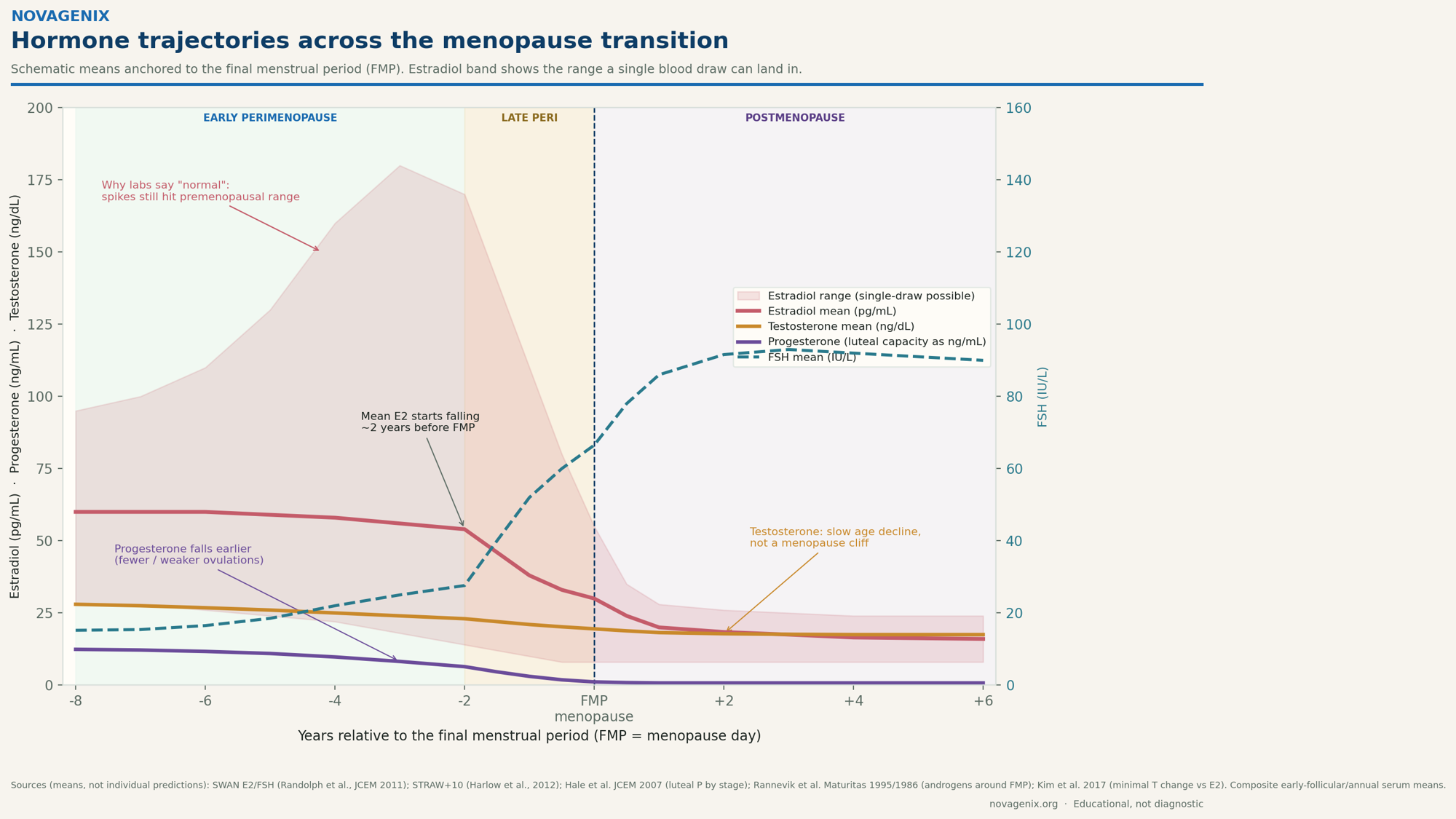
Typical population-level patterns—not a prediction for any individual. Estradiol can fluctuate widely during perimenopause, which helps explain why a single blood draw may appear “normal.”
How long it lasts
Cleveland Clinic gives an average of about four years, up to eight, usually starting in the mid-forties — though it can start earlier. New irregular or absent periods before age 40 deserve evaluation for premature ovarian insufficiency and other causes; they should not simply be assumed to be ordinary perimenopause. The National Institute on Aging notes separately that menopause-related symptoms can last between two and eight years, with timing highly variable from woman to woman.
You can still get pregnant
This one gets missed constantly, and the consequences are real. Cleveland Clinic states it plainly: "Yes, you can still become pregnant. You may be less likely to get pregnant during perimenopause, but it's still possible."
Irregular does not mean infertile. If you do not want to be pregnant, you still need contraception until you have reached menopause — and which method is appropriate is a conversation with your OB-GYN or primary care physician, because some options interact with the symptoms you may also be trying to treat.
What menopause actually is
Menopause is one day on the calendar: your final menstrual period. You just cannot know which day it was until a year has gone by. The World Health Organization puts it this way — "Natural menopause is deemed to have occurred after 12 consecutive months without menstruation for which there is no other obvious physiological or pathological cause and in the absence of clinical intervention."
Most women reach it between 45 and 55. In the United States, the average age is 52.
After that day, you are postmenopausal, and you remain postmenopausal for the rest of your life. There is no third act where the hormones come back.
Two things about that definition are worth sitting with. First, it is retrospective — the diagnosis is made by looking backward, which means nobody can tell you in the moment that today is the day. Second, it requires that no other cause explains the missing periods. Thyroid disease, certain medications, hormonal contraception, an IUD, significant weight change, and other conditions can all stop or mask periods. Ruling those out is a real clinical step, not a formality — and it is one of the genuinely good reasons to be evaluated rather than to assume.
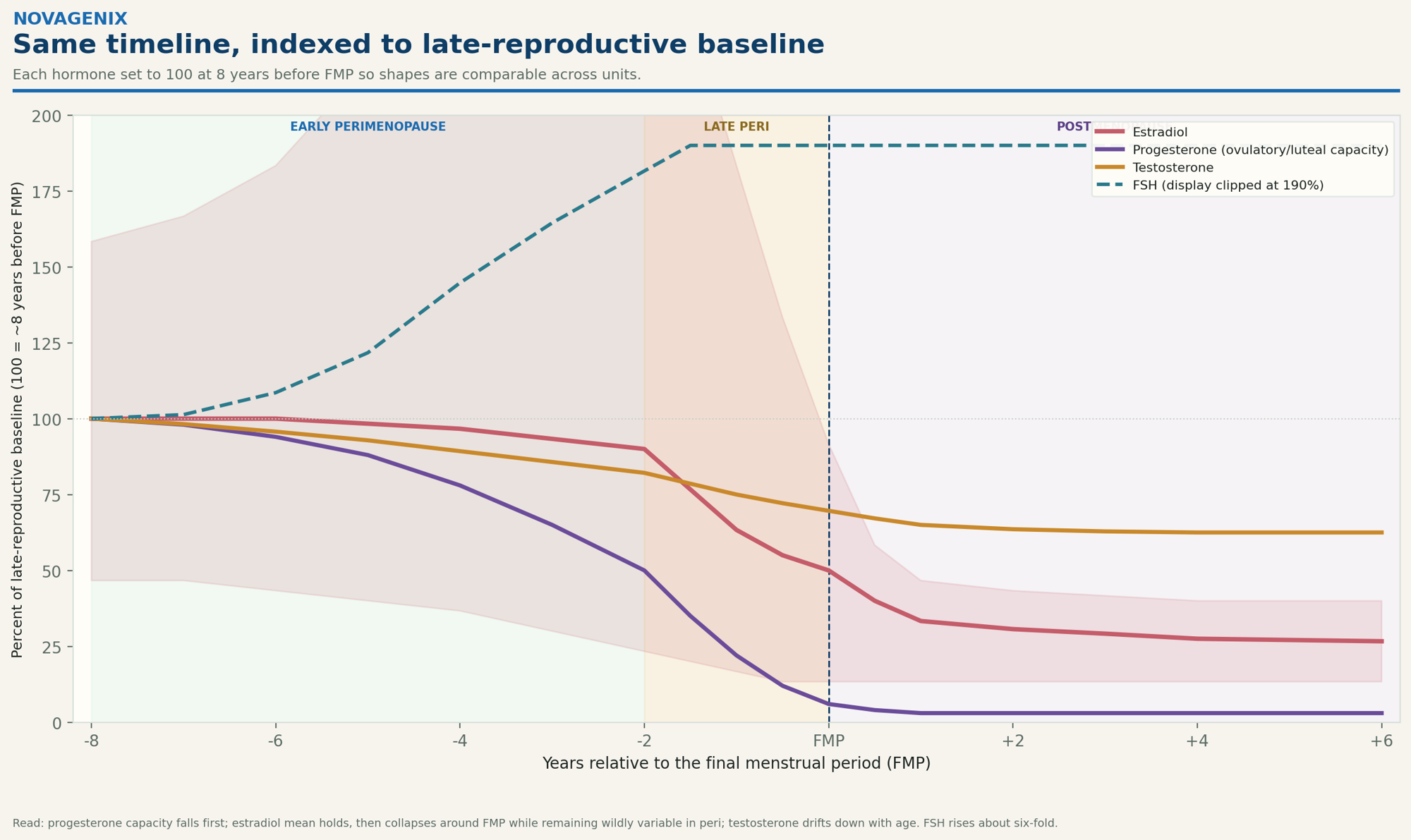
The same transition indexed to a late-reproductive baseline so differently measured hormones can be compared on one scale.
Side by side
Perimenopause
The transition
A transition lasting years
Typical duration
About 4 years on average; 2–8 years is common
Typical age
Often begins in the mid-40s
Periods
Still happening, but length, flow, and spacing may shift
Estrogen
Fluctuates unpredictably—sometimes high, sometimes low
Pregnancy
Still possible; contraception may still be needed
How it is identified
Clinically, from symptoms and cycle changes
Menopause & postmenopause
The milestone and the years after
A single retrospective milestone, followed by postmenopause
Typical duration
Menopause is one day; postmenopause is permanent
Typical age
Usually 45–55; U.S. average is 52
Periods
None for 12 consecutive months
Estrogen
Consistently low
Pregnancy
Not possible naturally
How it is identified
Retrospectively—12 months without a period, with other causes excluded
Why your bloodwork said "normal"
This is the part I most want you to have, because it is the part that makes women stop trusting their own experience.
A hormone panel usually cannot diagnose perimenopause, and a "normal" result does not mean nothing is happening.
Key point: A single hormone test is a snapshot. Perimenopause is identified primarily through your cycle pattern, symptoms, medical history, and exclusion of other causes.
That is not my opinion, and it is not a NovaGenix marketing position. Mayo Clinic states it directly: "There is no single test or symptom to tell if you've started perimenopause," and — apart from checking your thyroid — "hormone testing isn't usually helpful to know if you're in perimenopause. That's because hormone levels in perimenopause change unpredictably." Cleveland Clinic says the same thing: "Hormone testing isn't necessary to diagnose perimenopause. Hormone levels fluctuate so much that the tests aren't reliable."
Think about what that means mechanically. A blood draw is a photograph. Perimenopause is a film in which the lighting changes minute to minute. Draw your FSH on a Tuesday and it may read squarely in the normal range; draw it eleven days later and it may not. Neither number is wrong. Neither number is the answer.
So if you were told your labs were normal and you left feeling dismissed — the labs probably were normal. The inference drawn from them was the problem.
Then what are labs for?
For more on laboratory interpretation, read Estrogen Levels in Women.
They are still worth doing, but for a different job than most women assume. Bloodwork is not there to confirm perimenopause. It is there to rule out the other things that look exactly like it — thyroid disorders in particular, along with anemia, and other conditions that produce fatigue, mood change, cycle disruption and brain fog. It also establishes a baseline before any treatment begins, and gives a clinician something to measure against if treatment starts.
Diagnosis of perimenopause is clinical. It is made from your history, your cycle pattern and your symptoms — which is to say, it is made from listening to you. Labs support that conversation. They do not replace it.
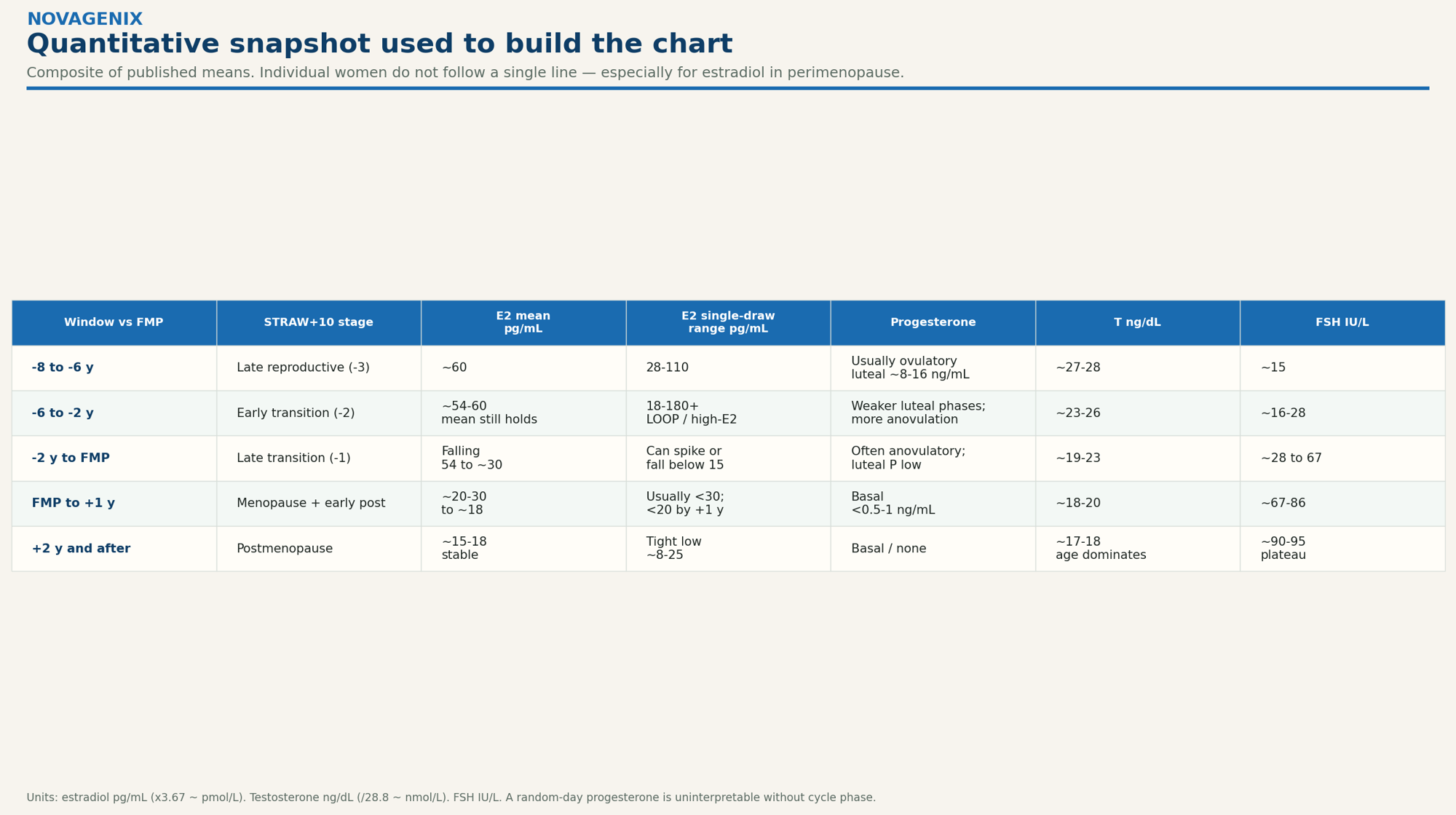
A quantitative reference assembled from published means. Individual values—especially estradiol during perimenopause—can vary substantially.
The symptoms that fade — and the one that doesn't
Most women assume they need to wait this out. For some symptoms, that is roughly true. For one important category, it is not, and nobody tells you.
Hot flashes and night sweats usually do improve — but "eventually" is longer than you have been led to believe. The Study of Women's Health Across the Nation followed 1,449 women with frequent vasomotor symptoms and found a median total duration of 7.4 years. Among the 881 of them whose final menstrual period could be pinpointed, symptoms persisted a median of 4.5 years after that period. Half the women in that study had them longer than that. Seven years is not a phase you power through with a desk fan.
Genitourinary symptoms are different, and this is the one to know. Vaginal dryness, pain with sex, burning, urinary urgency and recurrent UTIs are grouped under the term genitourinary syndrome of menopause. According to the Menopause Society's 2020 position statement, it affects roughly 27% to 84% of postmenopausal women, and — unlike hot flashes — "GSM is generally progressive without effective therapy."
It does not burn itself out. Waiting does not help. And it is the symptom women are least likely to raise unprompted, which means it is the one most often left untreated for years. If that paragraph described you, please say it out loud to a clinician. You will not be the first person that week.
So what can actually be done
I want to be careful here, because this is where a lot of websites stop being informative and start selling. So: this is a summary of what is established, not a recommendation for you. What is right for you depends on your history, your symptoms, your risk factors and your preferences, and it has to be worked out with a physician who has evaluated you.
Hormone therapy is, per the Menopause Society's 2022 position statement, the treatment that "remains the most effective treatment for vasomotor symptoms (VMS) and the genitourinary syndrome of menopause." That same statement is specific about who it suits: "For women aged younger than 60 years or who are within 10 years of menopause onset and have no contraindications, the benefit-risk ratio is favorable for treatment of bothersome VMS and prevention of bone loss." It is equally specific about how it should be handled: "Treatment should be individualized using the best available evidence to maximize benefits and minimize risks, with periodic reevaluation."
Note what that does not say. It does not say hormone therapy is right for every woman, and it is not appropriate for everyone. Certain histories — including some cancers, clotting disorders, liver disease and unexplained vaginal bleeding — change the calculation or rule it out. That determination requires an evaluation, not a website.
Local vaginal estrogen is worth naming separately, because women often assume it is the same decision as systemic hormone therapy. It is dosed and considered differently, and the 2020 position statement lists low-dose vaginal estrogen among the effective treatments for moderate to severe GSM.
Non-hormonal options exist and are real medicine, not consolation prizes. Mayo Clinic lists SSRIs, gabapentin, and the newer non-hormonal medications fezolinetant and elinzanetant for hot flashes, along with oxybutynin — a bladder medication that can also reduce hot flashes. If hormone therapy is not appropriate for you, or you simply do not want it, you have not run out of options.
Fezolinetant (Veozah) has an FDA boxed warning for rare serious liver injury. Liver tests are required before treatment, monthly for the first three months, and at months 6 and 9. Stop the medicine and contact the prescriber immediately for possible liver-injury symptoms such as jaundice, dark urine, unusual fatigue or abdominal pain. See FDA’s safety update.
For guidance on diagnostic exceptions and abnormal bleeding, see NICE’s menopause recommendations and ACOG’s bleeding guidance.
A word about "bioidentical." The term gets used loosely and it is worth being precise. Some bioidentical hormones — estradiol and micronized progesterone among them — are FDA-approved, well-studied pharmaceutical products. Custom-compounded preparations are a different category, and the Menopause Society's 2022 statement is blunt about them: they present "safety concerns, such as minimal government regulation and monitoring, overdosing and underdosing, presence of impurities and lack of sterility, lack of scientific efficacy and safety data, and lack of a label outlining risks." ACOG addressed the same question in its 2023 clinical consensus on compounded bioidentical menopausal hormone therapy.
If a clinic offers you something described as bioidentical, it is entirely reasonable to ask which of those two categories it falls into. Ask us that too. NovaGenix prescribes both: FDA-approved products where they meet the clinical need, and a compounded preparation in the specific situations where they do not. If what you are prescribed here is compounded, you will be told that it is compounded and why. Our progesterone therapy page sets that out in more detail, and says it plainly rather than blurring the two.
Start with your OB-GYN or your primary care physician
I mean this, and I am aware of how it reads on a hormone clinic's website.
If you have a gynecologist or a primary care physician you trust, that relationship is the right place to begin. They have your history. They can order the workup that rules out thyroid disease and anemia. They can manage contraception, arrange your mammogram and bone density screening, and treat a great deal of this themselves. Many are excellent at menopause care.
What I would ask is that you go in prepared, because fifteen minutes goes fast:
And if that conversation goes well, you may not need us at all. That is a perfectly good outcome.
When women come to us instead
Some women arrive at NovaGenix having already done all of that. Others want a second opinion, or a practice whose day is built around hormone evaluation rather than fitting it between prenatal visits. We see women from Jupiter, Palm Beach Gardens, Tequesta, Juno Beach and across northern Palm Beach County, and the reason they give is usually some version of I wanted someone to actually take the time.
Here is how it works, stated plainly so there are no surprises.
A physician evaluates you. Timothy Mackey, D.O. is our medical director — Florida license OS9185, in clinical practice for more than two decades and leading NovaGenix since 2018. Hormone therapy here is prescribed by a physician after an evaluation. We do not prescribe on the basis of an online questionnaire, and if any clinic offers to, that should concern you.
Lab work and a real conversation come before any hormone prescription. We look at what else could explain your symptoms before concluding it is hormonal.
Treatment is individualized. There is no NovaGenix protocol that every woman receives. Your history, your symptoms, your risk factors and your preferences determine what is appropriate — and for some women the answer is that hormone therapy is not appropriate, or that watchful waiting is reasonable. We will tell you that if it is true. Choosing not to use hormones remains a valid outcome, and you do not need to arrive having already decided.
We follow all applicable federal and Florida law governing prescribing, telehealth and medical advertising. That constrains what we can promise you, and it should.
We do not accept or work with insurance. NovaGenix is a direct-pay practice and is not in-network with any insurance plan. We do not bill insurers and we do not submit claims for you. We can give you a superbill — an itemized receipt — to submit to your insurer yourself; whether your plan reimburses anything is between you and them, and we cannot promise that it will. Some women find that frustrating; others find that knowing the cost in advance, with no claim denials and no surprise billing, is worth it. Either way, you should know it before you call rather than after. Ask us what your evaluation and labs cost when you call — we will tell you.
No one can promise you a specific result, and we will not. What we can tell you is what we would evaluate, what the options are, what they involve, and what the evidence actually supports.
Frequently asked questions
How do I know if I'm in perimenopause or menopause?
Irregular cycles together with typical symptoms can suggest perimenopause, but bleeding alone does not establish the stage. Natural menopause is usually confirmed after 12 months without a period when another cause does not explain the change. Any bleeding after established menopause needs evaluation. Hormonal contraception, hysterectomy and symptoms before age 40 require a different diagnostic approach; a clinician may use targeted hormone testing when appropriate.
What are the stages of perimenopause?
The STRAW+10 system describes an early menopausal transition, marked by a persistent difference of seven days or more in the length of consecutive cycles, and a late menopausal transition, marked by a gap of 60 days or more without a period. The late transition lasts one to three years on average. Postmenopause follows the final menstrual period.
At what age does perimenopause typically start?
Usually the mid-40s, though it can begin earlier. Menopause itself most often occurs between 45 and 55, with a US average of 52. Reaching menopause before 45 is described as early menopause and is worth evaluating.
Can I still get pregnant during perimenopause?
Yes. Pregnancy is less likely but remains possible until you have reached menopause. Irregular cycles are not a form of contraception.
Is perimenopause or menopause worse?
Neither is universally worse, and comparing them is less useful than it sounds. Many women find perimenopause harder because the hormonal swings are unpredictable and because they are usually managing it without a name for it. Symptom severity varies enormously — some women have few symptoms at any stage.
Do I have to stop seeing my OB-GYN if I come to NovaGenix?
No, and we would rather you didn't. Your gynecologist handles screening, gynecologic care and much more that we do not. We are happy to be one part of your care, not a replacement for it.
Does NovaGenix take insurance?
No. NovaGenix does not accept or work with insurance and is not in-network with any plan. Care is paid for directly. We can provide a superbill you may submit to your insurer yourself for possible out-of-network reimbursement, though we cannot guarantee your plan will reimburse anything. Call 561-277-8260 and we will tell you what an evaluation costs before you book anything.
Where to go from here
A normal hormone result does not exclude perimenopause. Other normal test results may help rule out specific conditions, depending on what was measured. Persistent symptoms still deserve a clinical evaluation.
Start tracking your cycles today — dates and length, nothing elaborate. Book the conversation with your OB-GYN or primary care physician. Say the genitourinary symptoms out loud. And if you want a physician-led evaluation focused specifically on this, our women's hormone therapy page explains what we do and how we think about it, or you can call or text 561-277-8260.
If you are weighing whether treatment makes sense, our guide to the signs you may need hormone therapy covers which symptoms respond best, who should avoid it and what changed in 2026. If anxiety or panic is your main symptom, read our guide to perimenopause anxiety.
You have possibly another thirty or forty years on the other side of this. It is worth an hour of someone's full attention.
Florida license OS9185 · Medical Director, NovaGenix
This article is general health information, not medical advice, and it is not a substitute for evaluation by a physician who knows your history. Hormone therapy is not appropriate for everyone. Individual results vary and no outcome is guaranteed. NovaGenix does not accept or work with insurance.
Medical references
Questions about treatment options?
Speak with NovaGenix about physician-led evaluation, testing, and treatment options in Jupiter, Florida.
Medical disclaimer: This article is for general educational purposes only and is not medical advice, a diagnosis, or a treatment recommendation. Reading it does not create a physician-patient relationship. Always consult a qualified healthcare professional about your individual circumstances, and never delay seeking care because of something you read here. If you are experiencing a medical emergency, call 911. Read our full Medical Disclaimer.

Contact Us
Blood Work Request Form
Request a hormone lab panel. Current NovaGenix patients can request follow-up labs, and new patients can request baseline labs before an evaluation.
Male Hormone Lab Panel: CBC, comprehensive metabolic panel, total and free testosterone, sensitive estradiol, TSH and PSA. Dr. Mackey may add LH, FSH, SHBG or other tests when clinically indicated.
Women's Hormone Lab Panel: CBC, comprehensive metabolic panel, total and free testosterone, estradiol, TSH and progesterone. Dr. Mackey may add FSH, IGF-1, cortisol or other tests when clinically indicated.
Standard hormone lab panels are $125 per panel, billed separately. If additional tests are requested, the price may increase; NovaGenix confirms your total before sending your lab requisition. You then schedule your blood draw with Labcorp at the date, time and location that work best for you.
Request a Lab Panel →
609 N Hepburn avenue suite 106. Jupiter, Florida 33458

609 N Hepburn avenue suite 106. Jupiter, Florida 33458

561-277-8260

Schedule a Consultation
Learn what you want to know about hormone therapy by scheduling a free consultation.
Contact Us Today609 N Hepburn Ave Ste 106, Jupiter, FL 33458
Monday - Friday: 9:00 am - 5:00 pm | Saturday-Sunday: Closed