


.png)


Women’s sexual health in Jupiter, Florida
When your desire changes, you deserve a real conversation
Maybe sex is simply not crossing your mind. Maybe you miss feeling interested, connected, or like yourself. Or maybe intimacy has become uncomfortable, so desire naturally moved farther away. Whatever brought you here, low sexual desire is common—and it is not something you have to explain away or feel embarrassed about.
At NovaGenix, the first step is not assuming you need hormones. It is listening to what changed, how it is affecting you, and what else may be happening in your body and your life.
You are not “broken.” Desire is personal, and there is no single number that defines what is normal. It becomes a medical concern when the change is persistent, bothers you, and affects your well-being or relationships.

Start with the whole picture
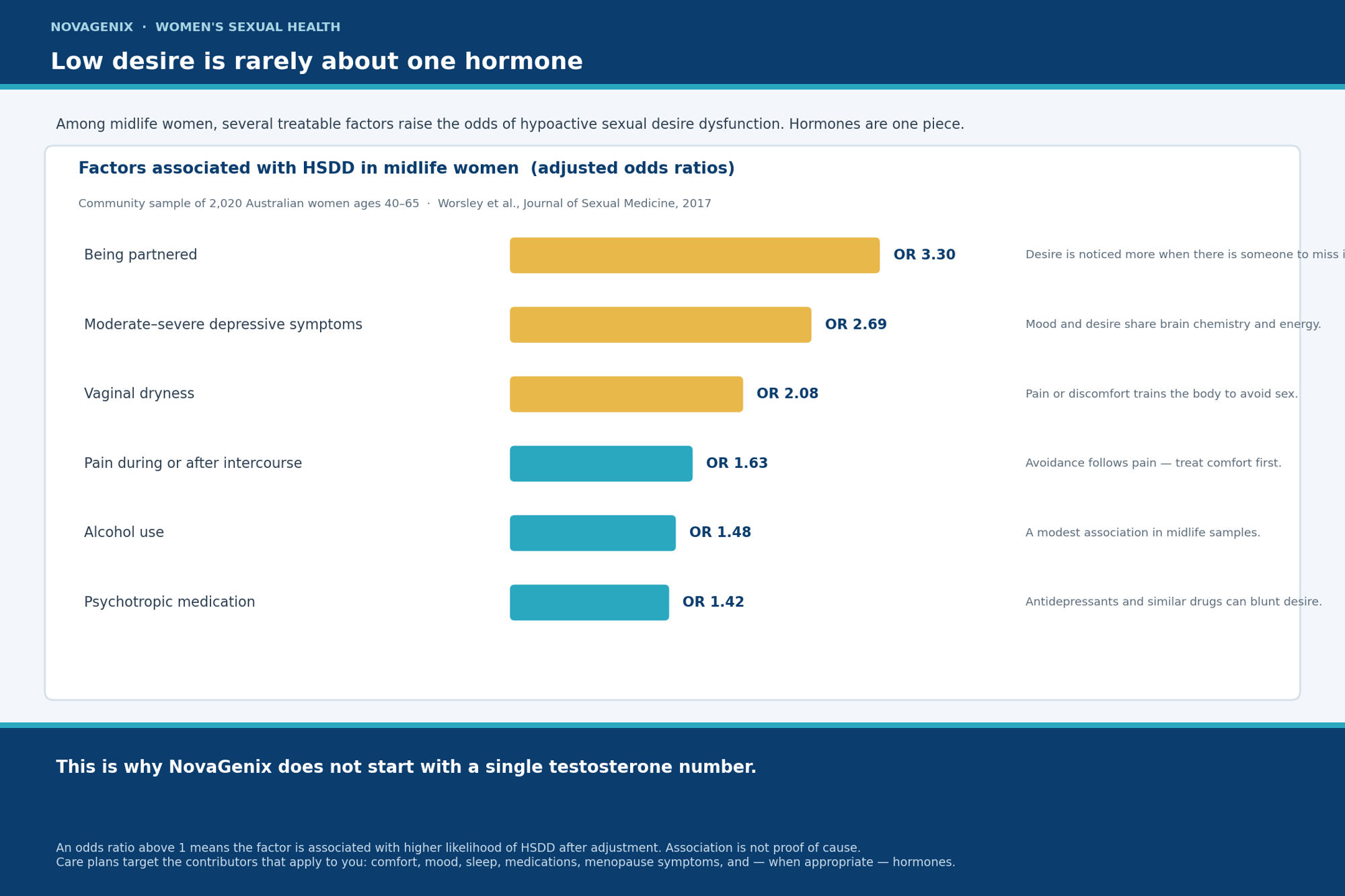
Low desire is rarely about just one hormone
Sexual desire reflects the brain, hormones, physical comfort, health, medications, stress, sleep, relationships, and life stage. Several of these can overlap, which is why a thoughtful evaluation matters more than a quick prescription.
Hormonal changes
Perimenopause, menopause, pregnancy, breastfeeding, ovarian surgery, and other changes can affect estrogen, progesterone, and androgen signaling. Hot flashes, poor sleep, and shifting mood can also quietly reduce interest.
Dryness or pain
When intimacy burns, hurts, or feels uncomfortable, your body may begin to avoid it. Vaginal dryness, genitourinary syndrome of menopause, pelvic-floor concerns, and other gynecologic conditions deserve direct attention.
Medications and health
Some antidepressants and other medicines may affect desire or orgasm. Thyroid conditions, elevated prolactin, anemia, diabetes, chronic pain, and sleep problems may also play a role.
Stress and emotional health
Anxiety, depression, body-image concerns, past trauma, caregiving, and mental overload can leave little room for desire. These are real health factors—not personal failures.
Relationship and context
Feeling emotionally disconnected, rushed, pressured, or unsupported can change sexual interest. Some women experience responsive desire, meaning interest appears after closeness begins rather than before it.
Energy and recovery
Long workdays, fragmented sleep, overtraining, alcohol use, and the nonstop demands of daily life can affect both physical energy and emotional availability.
A name you may hear
What is HSDD?
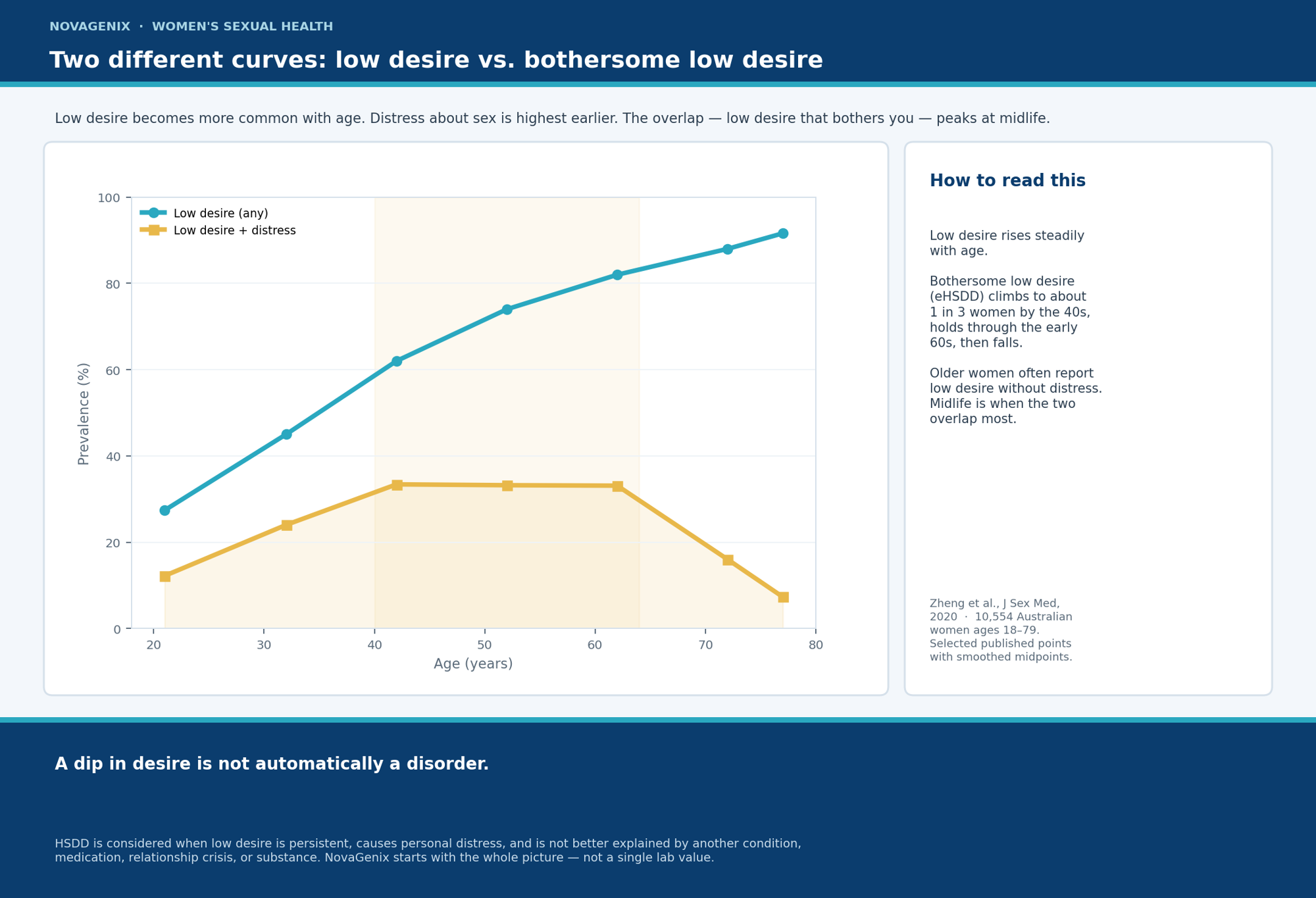
Hypoactive sexual desire disorder, or HSDD, describes an ongoing loss of sexual desire that is troubling to you and is not better explained by another medical condition, mental-health concern, relationship issue, medication, or substance.
Not every dip in desire is HSDD. Desire often changes during stressful seasons, after childbirth, through menopause, or when sex is uncomfortable. A diagnosis should fit your experience—not force your experience into a label.
Your evaluation
What a thoughtful visit looks like
You should not have to arrive with the right medical words. You can simply explain what feels different. From there, the evaluation is built around you.
We listen first
When did the change begin? Is desire absent, lower than before, or only different in certain situations? Are there changes in arousal, orgasm, comfort, mood, sleep, or your relationship?
We review the possible contributors
Your health history, menstrual or menopause stage, medications, surgeries, pregnancy history, stress, and other symptoms help shape the next step.
We order only useful testing
Laboratory testing may include thyroid, prolactin, blood count or iron markers, metabolic health, and selected hormone levels when clinically appropriate. A single testosterone result does not diagnose HSDD.
We build a shared plan
Your plan may involve treating discomfort, adjusting a contributing medication with the prescribing clinician, addressing sleep or mood, considering hormone or nonhormone options, or coordinating specialized care.
Treatment is personal
The right plan depends on the reason
There is no universal “libido treatment.” The most useful care targets the factors that are actually affecting you.
Comfort comes first
If dryness, irritation, or pain is present, treatment may include moisturizers or lubricants, local vaginal therapies, pelvic-floor therapy, or a gynecologic evaluation. Making intimacy comfortable can change the entire conversation.
Menopause symptom care
Menopausal hormone therapy may be considered for appropriate women with hot flashes, night sweats, sleep disruption, or genitourinary symptoms. It is not automatically a treatment for low desire, and benefits and risks should be reviewed individually.
Nonhormonal HSDD medication
Flibanserin is an FDA-approved daily medicine for certain women under age 65 with acquired, generalized HSDD. Bremelanotide is an as-needed injectable option approved for certain premenopausal women. Each has specific safety considerations and is not appropriate for everyone.
Sexual-health support
Sex therapy, counseling, mindfulness-based approaches, or relationship support can be useful—alone or alongside medical treatment. This is not a suggestion that the concern is “all in your head.” It recognizes that sexual health includes body, mind, and connection.
Could testosterone help?
For some postmenopausal women with carefully evaluated HSDD, systemic testosterone may be considered after modifiable causes have been addressed. In the United States, testosterone is not FDA-approved specifically for sexual dysfunction in women, so this use is off-label.
When it is considered, the conversation should include realistic benefits, possible side effects, formulation, dosing, and monitoring. Treatment should aim to keep levels within the physiologic range for women—not create supraphysiologic levels. Long-term safety data remain limited.
Important: A “low” blood testosterone value by itself does not prove that testosterone is the answer. Symptoms, history, examination, other contributors, and your preferences all matter.
What to expect
Progress should feel meaningful to you
No pressure, no promises
The goal is not a particular frequency of sex and no treatment can guarantee an outcome. Success may mean more interest, less distress, greater comfort, easier arousal, or simply understanding what changed.
Follow-up matters
If medication or hormone therapy is used, follow-up helps assess benefit, side effects, dosing, and whether continuing treatment still makes sense.
Your plan can change
Sexual health changes with life. A plan that fits now may need to evolve with menopause, health conditions, medications, relationships, or personal priorities.
Common questions
Answers without the awkwardness
Is low testosterone always the reason for low desire?
No. Desire can be affected by hormones, but there is no single testosterone cutoff that diagnoses sexual dysfunction in women. Sleep, stress, pain, medications, health conditions, and relationship context may be just as important.
Can menopause lower my sex drive?
It can. Hormonal changes may affect comfort, sleep, mood, energy, and sexual response. But menopause does not affect every woman the same way, and low desire should not automatically be blamed on age.
What if sex has become painful?
Please mention it. Dryness and pain are common but treatable, and they may point to genitourinary syndrome of menopause, pelvic-floor concerns, infection, dermatologic conditions, or another issue that deserves evaluation.
Will I need blood work?
Possibly. Testing is individualized and may help evaluate thyroid function, prolactin, anemia, metabolic health, or hormone status. Blood work is one part of the picture, not the entire diagnosis.
Is testosterone FDA-approved for women?
No testosterone product is currently FDA-approved in the United States specifically to treat sexual dysfunction in women. When used for appropriately evaluated HSDD, it is prescribed off-label and requires informed discussion and monitoring.
Can I start with a telehealth visit?
Eligible Florida patients may be able to begin by telemedicine. An in-person examination, laboratory testing, or referral may still be recommended when clinically appropriate.
When not to wait
Seek prompt medical care for new pelvic pain, bleeding after sex or after menopause, a breast change, severe depression, or symptoms that began suddenly with another neurologic or medical concern. If intimacy is pressured or unsafe, support is available and your safety comes first.

Private, physician-led care
Let’s talk about what changed
You do not need to diagnose yourself before asking for help. Timothy Mackey, D.O., can review your symptoms, health history, medications, and goals, then explain which next steps are—and are not—appropriate for you.
A consultation does not guarantee a prescription. Treatment decisions are individualized and based on medical appropriateness.
Medical references
- ADDYI Medication Guide (2025)
- VYLEESI Prescribing Information
- ISSWSH Clinical Practice Guideline on Systemic Testosterone for HSDD
- Global Consensus Position Statement on Testosterone Therapy for Women
- The Menopause Society Position Statements
- Shifren JL, et al. Sexual Problems and Distress in United States Women. Obstetrics & Gynecology. 2008.
- West SL, et al. Prevalence of Low Sexual Desire and Hypoactive Sexual Desire Disorder in a Nationally Representative Sample of US Women. Archives of Internal Medicine. 2008;168(13):1441–1449.
- Zheng J, et al. Low Sexual Desire With Associated Distress Across the Adult Life Span. Journal of Sexual Medicine. 2020.
- Worsley R, et al. Prevalence and Predictors of Hypoactive Sexual Desire Disorder in Midlife Women. Journal of Sexual Medicine. 2017.
- Australian Women’s Midlife Years (AMY) study. Sexual Dysfunction in Women at Midlife. The Lancet Obstetrics, Gynaecology & Women’s Health. 2025.
- Davison SL, et al. Androgen Levels in Adult Females: Changes With Age, Menopause, and Oophorectomy. Journal of Clinical Endocrinology & Metabolism. 2005.
- Maserejian NN, et al. Healthcare Utilization in Women With Hypoactive Sexual Desire Disorder. Journal of Women’s Health. 2010.
Page content is educational and does not replace individualized medical advice. Last medically reviewed September 2, 2026.



