
Connect with us


.png)

Schedule a Consultation!
Tesamorelin vs. HGH: How Are They Different?
Physician-reviewed hormone education
Tesamorelin vs. HGH
Two medications can affect the growth hormone–IGF-1 axis in very different ways. They are not interchangeable, and neither should be selected from symptoms alone.
Medically reviewed by Timothy Mackey, D.O.
Medical Director · Florida License OS9185 · Updated September 2026

PHYSICIANIndividual evaluation
FLORIDALicense OS9185
★★★★★4.9 Google rating
A+ · BBBAccredited rating
The short answer
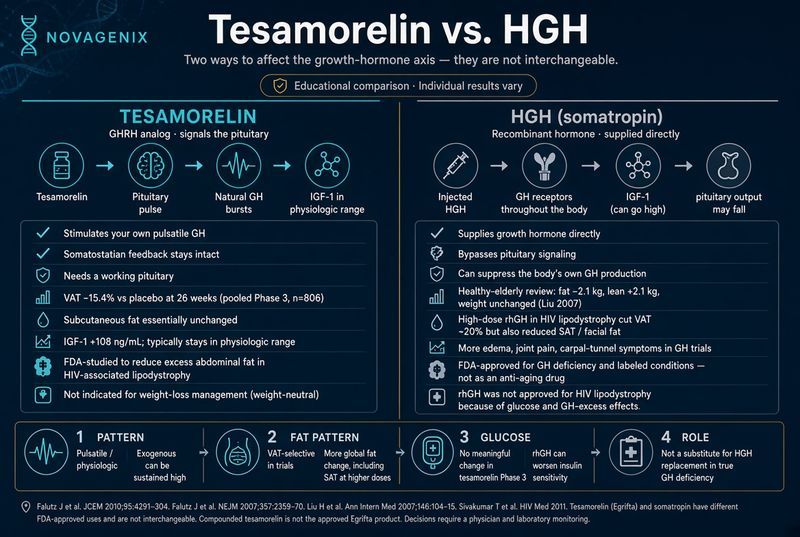
No—tesamorelin is not human growth hormone. Tesamorelin signals the pituitary gland to release endogenous growth hormone; somatropin supplies recombinant growth hormone directly. Their mechanisms, approved uses, risks, and monitoring differ.
A comparison can clarify those differences, but it cannot determine which medication—if either—is appropriate for an individual patient.
Tesamorelin vs. HGH at a glance
Tesamorelin
- GHRH analogue that signals a functioning pituitary
- Stimulates pulsatile endogenous GH release
- FDA-approved for excess abdominal fat in adults with HIV-associated lipodystrophy
- Not indicated for general weight-loss management
HGH (somatropin)
- Recombinant growth hormone supplied directly
- Acts at GH receptors throughout the body
- FDA-approved roles are product- and diagnosis-specific
- Not FDA-approved as an anti-aging or performance drug
What is synthetic HGH?
Human growth hormone is produced by the pituitary gland and influences growth, metabolism and body composition. “HGH” in a treatment context usually refers to recombinant human growth hormone, commonly somatropin, administered by injection as replacement therapy.
Because growth hormone is released in pulses rather than at a steady level, a single measurement is unreliable. Physicians typically assess growth hormone status indirectly through IGF-1, and in selected cases through formal stimulation testing.
FDA-approved uses in children
- Growth hormone deficiency — insufficient production leading to short stature and growth failure
- Turner syndrome — a chromosomal condition in females causing short stature and delayed puberty
- Chronic kidney disease — to address growth failure before transplant
- Prader-Willi syndrome — to improve growth and body composition
- Idiopathic short stature — significantly below-average height with no identifiable cause
- Small for gestational age — children born small who do not catch up by age two
FDA-approved uses in adults
- Adult growth hormone deficiency — resulting from pituitary or hypothalamic disease, surgery, radiation or trauma
- HIV/AIDS-related muscle wasting
- Short bowel syndrome — to improve intestinal absorption and nutritional status
Indications are product-specific. The diagnosis and treatment plan depend on the patient’s clinical history, laboratory evaluation and the approved labeling for the specific product.
Why most physicians decline off-label growth hormone requests
Synthetic HGH is not an FDA-approved anti-aging or athletic-performance treatment. Federal law under 21 U.S.C. § 333(e) restricts distribution of human growth hormone for human uses that are not authorized under the statute.
Age alone is not an FDA-approved indication for growth hormone therapy. Physicians generally require a documented medical condition, appropriate diagnostic evaluation and a treatment rationale consistent with applicable law and product labeling. If obtaining a growth hormone prescription has been difficult, this is usually the reason.
What is tesamorelin?
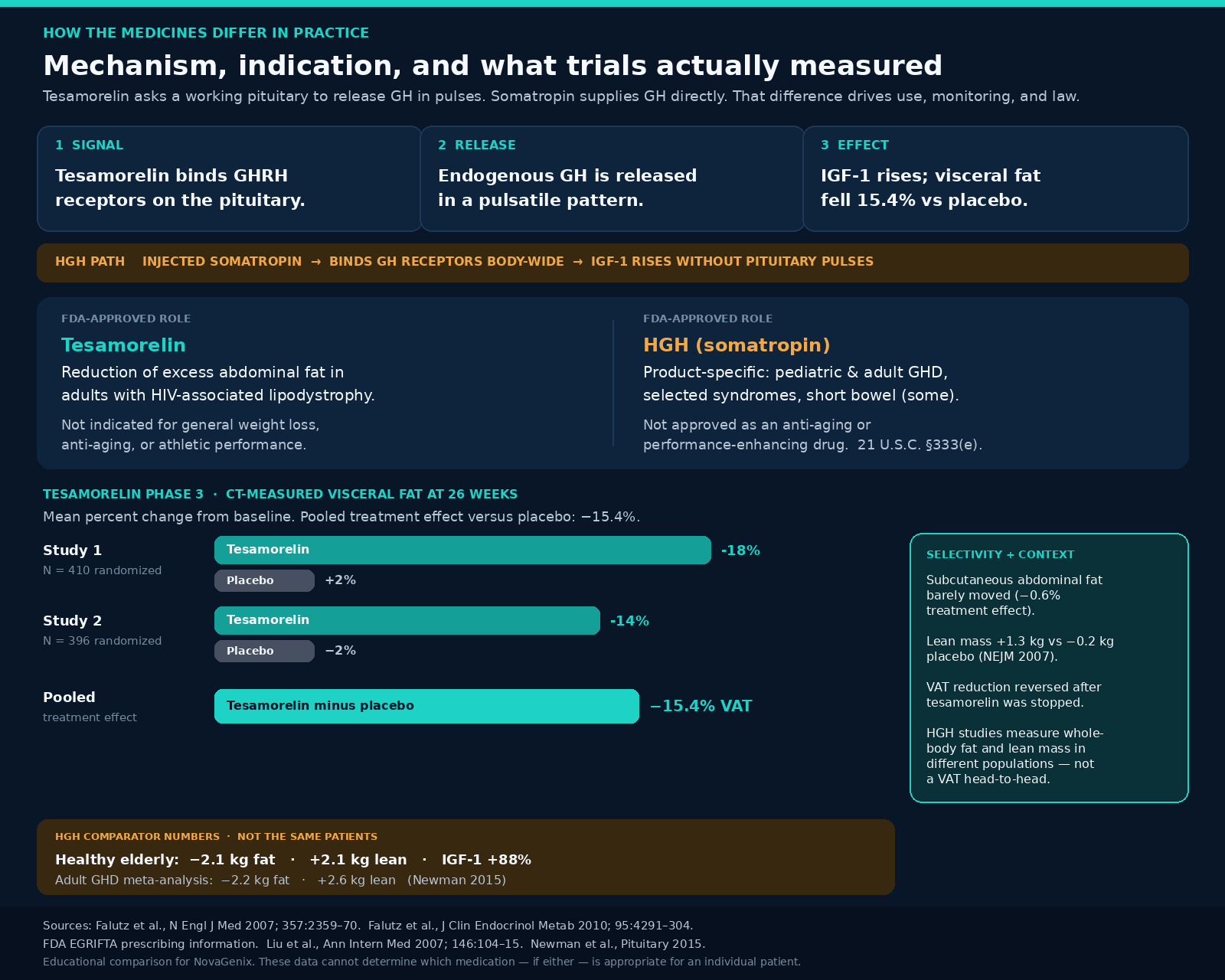
Tesamorelin is a synthetic analogue of growth hormone-releasing hormone. Instead of supplying growth hormone, it binds GHRH receptors in the pituitary and stimulates release of endogenous growth hormone, which can increase insulin-like growth factor 1 (IGF-1).
Tesamorelin is marketed as EGRIFTA SV® and EGRIFTA WR®. Its FDA-approved indication is the reduction of excess abdominal fat in adults with HIV-associated lipodystrophy. The prescribing information states that it is not indicated for weight-loss management; it is not FDA-approved for obesity, anti-aging, bodybuilding or athletic performance.
Learn about physician-guided tesamorelin therapy
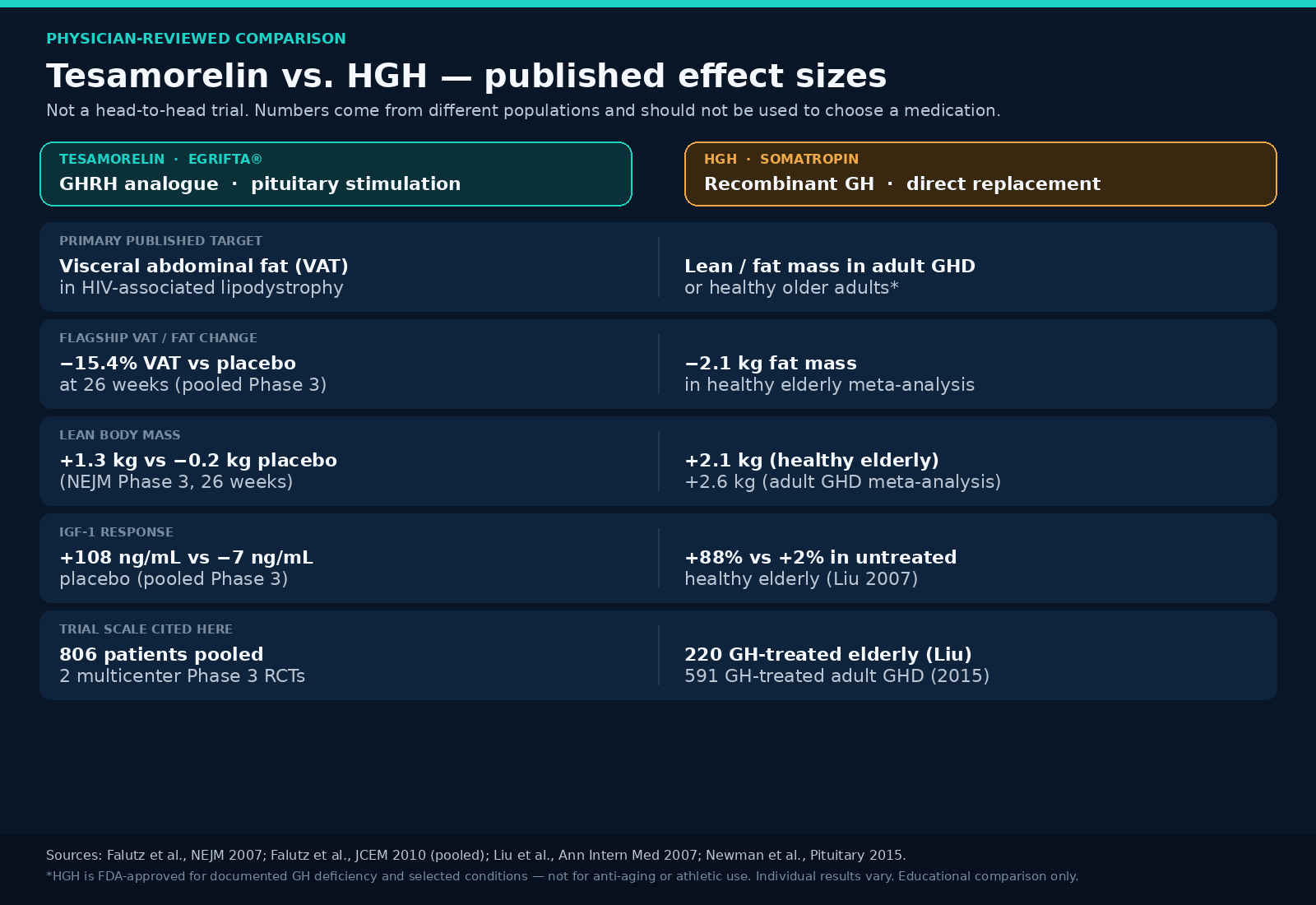
In Phase 3 evidence summarized by federal HIV clinical guidance, tesamorelin produced a 15.4% relative reduction in visceral adipose tissue compared with placebo over 26 weeks. Results vary, treatment requires medical monitoring, and abdominal fat may return after treatment stops.
How do tesamorelin and HGH work differently?
The simplest difference is stimulation versus replacement:
- Tesamorelin stimulates the pituitary gland to release growth hormone through the body’s existing signaling pathway.
- Somatropin supplies recombinant growth hormone and is used as replacement therapy for specific approved conditions.
Because their mechanisms and approved indications differ, a laboratory value or symptom does not automatically make someone a candidate for either medication. Growth hormone disorders may require IGF-1 testing, additional pituitary evaluation and, in selected cases, formal stimulation testing.
Which medication is used for which condition?
When HGH may be considered
A growth hormone product may be considered when a patient has a diagnosed condition covered by that product’s labeling, such as adult or pediatric growth hormone deficiency. Different products have different approved populations and indications, so the prescribing information matters.
When tesamorelin may be considered
Tesamorelin’s approved role is specifically excess abdominal fat in adults with HIV-associated lipodystrophy. A physician may discuss off-label use in other circumstances, but off-label use is not FDA approval, and the supporting evidence may be more limited.
For people seeking treatment primarily for fatigue, low libido, weight gain or reduced muscle mass, those symptoms are nonspecific. They may relate to testosterone, thyroid function, sleep, nutrition, metabolic health or other causes. The correct next step is evaluation — not choosing between HGH and tesamorelin based on symptoms alone.
Is tesamorelin safer than HGH?
It is not accurate to label one medication universally safer. Safety depends on the patient, diagnosis, dose, formulation, contraindications and monitoring.
Tesamorelin can cause injection-site reactions, joint or muscle symptoms, swelling, hypersensitivity, elevated IGF-1 and changes in glucose metabolism. Growth hormone products can also affect glucose metabolism and cause fluid retention, joint symptoms, nerve-compression symptoms and other product-specific adverse effects. Both require appropriate prescribing and follow-up.
Some safety considerations are also sex-specific. Tesamorelin is contraindicated in pregnancy, and women accounted for only 14% and 16% of participants in the two pivotal trials, so the evidence base is weighted toward male patients. Tesamorelin for women: benefits, safety and FDA status covers those considerations in detail.
Neither medication should be selected because it sounds “more natural.” Mechanism is only one part of a clinical decision; approved indication, evidence, contraindications and individual risk matter more.
Can tesamorelin and HGH be taken together?
Combining tesamorelin with somatropin is not an FDA-approved regimen, and an established clinical benefit has not been demonstrated. Because both affect the growth hormone–IGF-1 axis, combining them could increase exposure and monitoring concerns. A patient should not combine them without evaluation and explicit direction from a qualified prescribing physician.
How does tesamorelin compare with other peptides?
Tesamorelin vs. sermorelin
Both are GHRH analogues acting on the same receptor. Sermorelin is a shorter fragment with a briefer half-life. The practical difference is regulatory: tesamorelin holds a specific FDA approval, while sermorelin is not currently available as an FDA-approved commercial drug product and may be prescribed through appropriately licensed compounding pharmacies when legally and clinically appropriate.
Explore sermorelin therapy at NovaGenix
Tesamorelin vs. ipamorelin
Ipamorelin works through a different pathway. It is a growth hormone secretagogue acting on the ghrelin receptor rather than the GHRH receptor.
Ipamorelin’s compounding status has changed and remains subject to FDA’s evolving 503A framework. It is not an FDA-approved drug product. Current availability and legal eligibility should be confirmed with the prescribing clinician and dispensing pharmacy rather than inferred from older online lists.
Review NovaGenix’s ipamorelin therapy page
How do cost and access compare?
There is no single reliable cash-price comparison. Cost depends on the prescribed product, dose, pharmacy, insurance coverage, diagnosis and patient-assistance eligibility. Coverage is also tied to the medication’s approved indication and the patient’s documented medical condition.
Cost should not be used to treat tesamorelin and HGH as substitutes. The correct medication — if either is appropriate — depends first on the diagnosis and treatment objective.
Does tesamorelin increase testosterone?
Tesamorelin acts on the growth hormone–IGF-1 axis. Testosterone is regulated through a different hormonal pathway. Tesamorelin is not testosterone replacement therapy and should not be expected to correct clinically low testosterone.
Learn how NovaGenix evaluates possible low testosterone
Frequently asked questions
Is tesamorelin the same as HGH?
No. Tesamorelin is a GHRH analogue that stimulates pituitary growth hormone release. HGH treatment supplies recombinant growth hormone, usually somatropin.
Is tesamorelin a form of growth hormone?
No. Tesamorelin is a growth hormone-releasing hormone analogue. It stimulates growth hormone release but is not growth hormone itself.
Is tesamorelin better than HGH?
Neither is universally better. They have different mechanisms and approved indications. The appropriate choice depends on the diagnosis, evidence, contraindications and physician evaluation.
Can tesamorelin and HGH be used together?
The combination is not an FDA-approved regimen, and an established clinical benefit has not been demonstrated. Combining medications that affect the same hormonal axis requires specialist evaluation.
Does tesamorelin increase testosterone?
No. Tesamorelin acts on the growth hormone and IGF-1 axis. Testosterone is regulated through a different hormonal pathway, and tesamorelin is not testosterone replacement therapy.
Is tesamorelin used differently in women?
The FDA label does not provide a sex-specific dose, but tesamorelin is contraindicated in pregnancy and women were a minority of pivotal trial participants. See tesamorelin for women for the full discussion.
Can tesamorelin make an adult taller?
No. Adult height does not increase after the growth plates have closed.
What is tesamorelin FDA-approved to treat?
Tesamorelin is FDA-approved to reduce excess abdominal fat in adults with HIV-associated lipodystrophy. It is not approved for general weight loss, obesity, anti-aging or athletic performance.
What is somatropin?
Somatropin is recombinant human growth hormone. FDA-approved somatropin products are prescribed for specific product-dependent conditions, including growth hormone deficiency and selected other indications.
Does a normal IGF-1 rule out growth hormone deficiency?
Not in every clinical situation. IGF-1 is an important screening measure, but diagnosis may require an endocrinologic evaluation and stimulation testing in appropriately selected patients.
How does tesamorelin compare with sermorelin?
Both are growth hormone-releasing hormone analogues acting on the same receptor. Tesamorelin holds a specific FDA approval, while sermorelin is not available as an FDA-approved commercial drug product and may be compounded only when legally and clinically appropriate.
How does growth hormone therapy differ from testosterone therapy?
They treat different hormone systems and are not interchangeable. Testosterone replacement addresses low testosterone. Growth hormone therapy addresses growth hormone deficiency, which is assessed through IGF-1 and, where indicated, stimulation testing.
How does hCG differ from growth hormone?
Human chorionic gonadotropin binds the LH receptor on testicular Leydig cells and may be prescribed in selected patients for a different clinical purpose. It has no direct effect on the growth hormone axis, and growth hormone has no direct effect on testicular testosterone production.
Is there an alternative to HGH?
GHRH analogues such as tesamorelin and sermorelin act through the body’s own signaling pathway and are sometimes discussed as alternatives. They are not equivalents. They have different approved indications, evidence bases and monitoring requirements. A medication is only an alternative if it is appropriate for the diagnosis in question.
Talk with a physician
Questions about tesamorelin, growth hormone, testosterone or peptide therapy should begin with a medical evaluation — not an online comparison alone. Dr. Timothy Mackey, D.O. reviews symptoms, medical history, medications and appropriate laboratory findings before making an individualized recommendation.
Schedule a consultation | Physician-guided tesamorelin therapy
NovaGenix Health & Wellness | 609 N. Hepburn Ave., Suite 106, Jupiter, FL 33458 | Call or text 561-277-8260
Medical disclaimer: This article is for educational purposes and does not provide individual medical advice, establish a physician-patient relationship or guarantee that any medication is appropriate. Treatment decisions require evaluation by a qualified healthcare professional.
Primary references for the published page
NIH ClinicalInfo: Weight Gain in People With Treated HIV
FDA: Weekly Therapy for Adult Growth Hormone Deficiency
U.S. Code, 21 U.S.C. §333(e): Prohibited Distribution of Human Growth Hormone
Endocrine Society: Growth Hormone Deficiency
FDA: Bulk Drug Substances Used in Compounding Under Section 503A
Questions about treatment options?
Speak with NovaGenix about physician-led evaluation, testing, and treatment options in Jupiter, Florida.
Medical disclaimer: This article is for general educational purposes only and is not medical advice, a diagnosis, or a treatment recommendation. Reading it does not create a physician-patient relationship. Always consult a qualified healthcare professional about your individual circumstances, and never delay seeking care because of something you read here. If you are experiencing a medical emergency, call 911. Read our full Medical Disclaimer.

Contact Us
Blood Work Request Form

609 N Hepburn avenue suite 106. Jupiter, Florida 33458

609 N Hepburn avenue suite 106. Jupiter, Florida 33458

561-277-8260

Schedule a Consultation
Learn what you want to know about hormone therapy by scheduling a free consultation.
Contact Us Today609 N Hepburn Ave Ste 106, Jupiter, FL 33458
Monday - Friday: 9:00 am - 5:00 pm | Saturday-Sunday: Closed