
Connect with us


.png)

Schedule a Consultation!
Stem Cell Therapy for Orthopedic Conditions: What the Research Says
ORTHOPEDIC REGENERATIVE MEDICINE: EVIDENCE BEFORE PROMISES
Stem Cell Therapy for Orthopedic Conditions: What the Research Says
Research findings differ by condition and product. An evaluation should explain the diagnosis, established alternatives, regulatory status and uncertainty. NovaGenix does not offer PRP.
Physician-led care with Dr. Timothy Mackey
Medical Director, NovaGenix
Presentation updated September 2026
★★★★★ 4.9 Google ratingBBB Accredited A+Call 561-277-8260Schedule a ConsultationText Us
Stem cell therapy for orthopedic conditions remains an evolving and contested area of medicine. Some studies report improvements in pain or function for selected patients, while other high-quality reviews find little or no clinically important benefit. Results vary by diagnosis, product, preparation, study design, and follow-up period. These therapies are not approved by the U.S. Food and Drug Administration (FDA) to treat orthopedic conditions.
In 2025, Florida established a state pathway allowing appropriately licensed physicians to provide certain non-FDA-approved stem cell therapies for orthopedics, wound care, or pain management when detailed sourcing, manufacturing, disclosure, and informed-consent requirements are met. The law did not grant FDA approval, prove effectiveness, or remove applicable federal requirements.
At NovaGenix Health & Wellness in Jupiter, Florida, regenerative medicine consultations are conducted under the medical direction of Timothy Mackey, D.O. The goal of an evaluation is to establish the diagnosis, review imaging and prior treatment, discuss conventional options, and determine whether further regenerative medicine evaluation warrants consideration. NovaGenix does not currently offer platelet-rich plasma (PRP). PRP is discussed below for educational comparison, not as an available NovaGenix service. No regenerative procedure can guarantee tissue regeneration, avoidance of surgery, or a particular result.
THIS NOTICE MUST BE PROVIDED TO YOU UNDER FLORIDA LAW.
This physician performs one or more stem cell therapies that have not yet been approved by the United States Food and Drug Administration. You are encouraged to consult with your primary care provider before undergoing any stem cell therapy.
Key takeaways
- PRP and stem cell or cellular tissue products are not interchangeable. PRP is prepared from a patient’s own blood; an allograft comes from donated human tissue.
- The FDA states that regenerative medicine therapies have not been approved for orthopedic conditions such as knee pain or tendinitis.
- Florida law permits certain physician-supervised, non-FDA-approved stem cell therapies under specified conditions. State authorization is not the same as federal approval.
- Evidence depends on the condition and treatment. PRP has supportive evidence for some chronic tendon disorders and mild-to-moderate knee osteoarthritis, but findings are not uniformly positive.
- Evidence for MSC-based treatment is mixed. A 2024 review of 16 randomized trials involving 807 people with knee osteoarthritis found little to no clinically important improvement in pain or physical function.
- Risks, alternatives, product source, regulatory status, cost, and realistic expectations should be reviewed before treatment.
- Some injuries and advanced joint disorders still require orthopedic or surgical care.
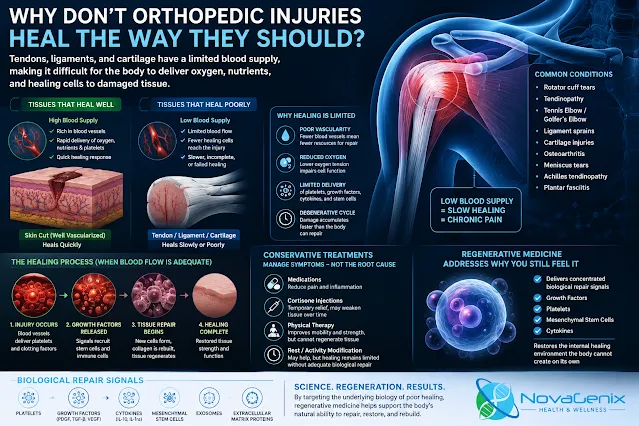
What is orthopedic regenerative medicine?
Orthobiologics are biological substances used with the aim of supporting healing or influencing the environment around an injured joint, tendon, ligament, muscle, or bone. The broad category includes treatments that differ substantially in source, composition, evidence, and regulatory status.
The word “regenerative” should not be interpreted as proof that a treatment regrows cartilage, repairs a tendon, or reverses arthritis. In clinical practice and research, many studies measure pain and function rather than confirming structural regeneration. A patient may report symptom improvement without imaging evidence that damaged tissue has been restored.
Platelet-rich plasma (PRP)
PRP is an autologous product, meaning it is prepared from the patient’s own blood. A blood sample is processed to concentrate platelets in plasma, and the preparation is injected into a selected area. Platelets release signaling proteins and growth factors involved in the body’s normal response to injury.
PRP preparations are not standardized. Platelet concentration, white-blood-cell content, processing method, injection technique, and the condition being treated can all influence study results. PRP should therefore be discussed as a family of preparations rather than a single uniform product.
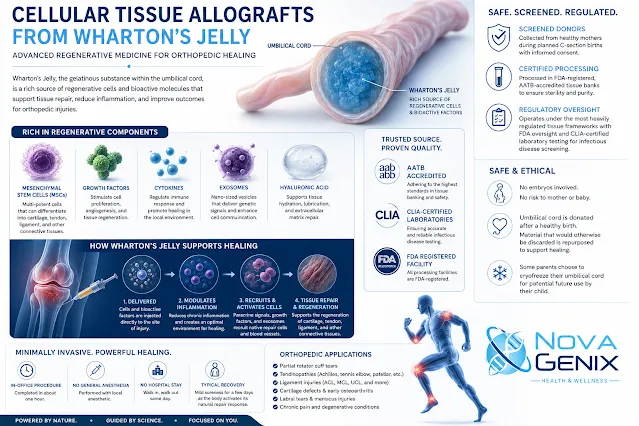
Wharton’s Jelly cellular tissue allografts
Wharton’s Jelly is connective tissue found in the umbilical cord. Products derived from donated perinatal tissue are allografts, not treatments made from the patient’s blood. Their composition, processing, viability, intended use, and regulatory classification can differ by manufacturer and lot.
Marketing terms such as “stem cell injection” should not substitute for the exact product name and documentation. Before any procedure, patients should be told precisely what product is proposed, where it came from, how it was processed, whether viable cells are documented, what accreditation or registration applies to the source facility, and whether the proposed orthopedic use is FDA approved.
Mesenchymal stromal or stem cells (MSCs)
MSCs are multipotent cells studied for their signaling, immune-modulating, and tissue-supporting properties. They may be derived from sources such as bone marrow, adipose tissue, or perinatal tissue. Laboratory mechanisms do not by themselves establish that an injected product will regenerate human cartilage or reliably improve a particular orthopedic condition.
PRP vs. cellular tissue allografts
PRP
- Source: The patient's own blood.
- Preparation: Concentrated platelets in plasma.
- Questions to ask: How is it prepared, what condition is being treated, and what evidence supports that use?
- Availability: NovaGenix does not currently offer PRP.
Cellular tissue allografts
- Source: Donated human tissue.
- Composition: Depends on the source, processing, labeling and lot documentation.
- Questions to ask: What is the exact product, what does it contain, and what evidence and regulatory status apply to its proposed use?
- Limitation: Findings about one preparation cannot automatically be applied to another.
What orthopedic conditions are being studied?
Regenerative procedures have been studied across a wide range of musculoskeletal conditions. Research activity does not establish that every treatment is effective or appropriate for every patient.
Knee osteoarthritis
Knee osteoarthritis is one of the most frequently studied applications. The evidence is not uniform. A 2024 systematic review and meta-analysis of 16 randomized trials with 807 participants concluded that intra-articular MSC injections probably produced little to no improvement in pain or physical function. It also found low-certainty evidence of increased adverse events, including post-injection pain and swelling.
Other reviews have reported more favorable results, illustrating how conclusions can change based on which trials, cell sources, comparators, doses, and outcome measures are included. This inconsistency is a reason to avoid claiming that MSC therapy reliably restores cartilage or prevents knee replacement.
PRP has a separate evidence base. The American Academy of Orthopaedic Surgeons (AAOS) reports that a growing body of literature supports PRP for some patients with mild-to-moderate knee osteoarthritis, while also emphasizing that preparation and patient factors can affect outcomes.
Chronic tendon disorders
PRP has been studied for chronic tendon conditions, including lateral epicondylitis, commonly called tennis elbow. AAOS describes evidence for some chronic tendon problems as favorable, particularly tennis elbow, but notes that evidence for Achilles and patellar tendon disorders is less conclusive.
Tendon pain may have several causes, and an injection is not a substitute for a clear diagnosis. Activity modification, progressive loading, physical therapy, medication when appropriate, bracing, and surgical consultation may remain part of care.
Shoulder and rotator cuff conditions
Research has evaluated PRP and cellular therapies for rotator cuff disease, tendinopathy, and partial tears. Outcomes differ according to whether a product is used as a stand-alone injection or as an adjunct during surgery. AAOS reports little or no demonstrated benefit for PRP used during some rotator cuff repair procedures. A complete tear, major weakness, trauma, or loss of function may require prompt orthopedic assessment.
Hip osteoarthritis and labral disorders
PRP and cell-based injections have been studied for hip osteoarthritis, but the evidence base is smaller and more variable than it is for the knee. Hip pain can also arise from labral injury, impingement, tendon disorders, referred back pain, or advanced structural disease. Diagnosis and imaging should guide any treatment discussion.
Plantar fascia, ankle, ligament, and other conditions
Regenerative products have also been studied for plantar fasciopathy, ankle instability, ligament injury, and other musculoskeletal problems. Evidence is condition-specific and often limited by small studies, inconsistent protocols, or short follow-up. These conditions should not be grouped together under a general promise of “healing.”
What does the research actually show?
The most accurate summary is that results are mixed and cannot be generalized across products or diagnoses.
For PRP, evidence is more developed for selected chronic tendon disorders and mild-to-moderate knee osteoarthritis than for many other orthopedic uses. Even in those settings, outcomes vary and additional research is needed.
For MSC-based interventions, published reviews do not reach a single conclusion. Some report changes in pain or function, while a rigorous 2024 meta-analysis found that the average improvements for knee osteoarthritis did not reach thresholds considered clinically important. Differences among cell source, dose, viability, processing, comparator treatment, trial quality, and follow-up make broad claims unreliable.
Patients should also distinguish three questions:
- Did participants report less pain?
- Did they function better?
- Did objective imaging or tissue analysis show meaningful structural repair?
A positive answer to one does not prove the others. Symptom improvement should not automatically be described as cartilage regrowth or tendon regeneration.
Is orthopedic stem cell therapy FDA approved?
No regenerative medicine therapy has been FDA approved specifically to treat orthopedic conditions such as knee pain or tendinitis. The FDA has warned that unapproved regenerative medicine products may carry risks including infection, immune or inflammatory reactions, contamination, unwanted tissue growth, and other serious adverse events.
This does not mean every product presents the same risk. It means patients should receive product-specific information and should not assume that FDA registration of a facility, tissue-bank accreditation, or permission under state law equals FDA approval of the treatment.
Patients considering a human cell or tissue product can ask:
- What is the exact product and manufacturer?
- Is the proposed use FDA approved?
- If it is investigational, is treatment being provided under an FDA-authorized investigational new drug application, and what is the IND number?
- What evidence supports this product for my exact diagnosis?
- What does the label state about intended use?
- How was the tissue screened, processed, stored, and tested?
- What are the known and unknown risks?
What did Florida Senate Bill 1768 change?
Effective July 1, 2025, Florida’s CS/CS/SB 1768 created sections 458.3245 and 459.0127 of the Florida Statutes. The law permits licensed medical and osteopathic physicians to perform certain non-FDA-approved stem cell therapies related to orthopedics, wound care, or pain management when the statute’s conditions are met.
Among other requirements, the law addresses facility registration and accreditation, post-thaw viability reporting, current good manufacturing practices, advertising disclosures, and written informed consent. The consent must address the nature of treatment, lack of FDA approval, anticipated results, recognized serious risks and complications, anticipated benefits, alternatives—including no treatment—and the option to consult a primary care provider.
The law is a state practice framework. It should not be described as proof that a treatment works, blanket legalization of every stem cell product, or replacement of federal FDA regulation.
What are the risks and limitations?
Potential risks depend on the procedure and product. They may include temporary pain or swelling, bleeding, infection, nerve or tissue injury, allergic or immune reaction, contamination, lack of benefit, worsening symptoms, and delay of an established treatment. Certain unapproved or more-than-minimally-manipulated cell products may present additional risks.
Other practical limitations include:
- Results are not predictable, and some patients do not improve.
- Most regenerative procedures are not covered by insurance.
- A procedure may not correct severe mechanical damage, instability, advanced arthritis, fracture, infection, or a complete tendon or ligament rupture.
- Published findings about one preparation should not be applied to a different product.
- Long-term safety and effectiveness data may be limited.
Who may—or may not—be a candidate?
Candidacy begins with diagnosis, not with choosing an injection. A physician should review symptoms, examination findings, imaging, medical history, medications, prior treatment, functional goals, and alternative care.
A regenerative procedure may warrant discussion when a patient has a defined musculoskeletal diagnosis, persistent symptoms despite appropriate conservative care, and a realistic understanding of the evidence and uncertainty.
It may be inappropriate—or require additional specialist review—when there is active infection, suspected cancer, uncontrolled medical illness, a bleeding disorder, use of certain anticoagulants, pregnancy, severe joint destruction, major mechanical instability, an acute fracture, a complete tendon rupture, or another condition requiring urgent or surgical treatment. This is not a complete list.
What should patients expect from a NovaGenix consultation?
At NovaGenix Health & Wellness in Jupiter, the consultation is designed to answer four questions:
- What is the most likely source of the pain or loss of function?
- What established treatments remain reasonable?
- What evidence supports PRP or a proposed cellular tissue product for this diagnosis?
- Do the potential benefits, uncertainties, risks, and costs justify consideration?
Patients should bring relevant imaging reports, prior treatment records, a current medication list, and questions about the exact product being considered. An evaluation does not guarantee candidacy, and regenerative medicine should not be presented as a universal alternative to surgery.
For a detailed overview of services, visit NovaGenix Regenerative Medicine in Jupiter, Florida. To request a physician consultation, use the NovaGenix contact page or call (561) 277-8260.
Florida free-service notice: THE PATIENT AND ANY OTHER PERSON RESPONSIBLE FOR PAYMENT HAS A RIGHT TO REFUSE TO PAY, CANCEL PAYMENT, OR BE REIMBURSED FOR PAYMENT FOR ANY OTHER SERVICE, EXAMINATION, OR TREATMENT THAT IS PERFORMED AS A RESULT OF AND WITHIN 72 HOURS OF RESPONDING TO THE ADVERTISEMENT FOR THE FREE, DISCOUNTED FEE, OR REDUCED FEE SERVICE, EXAMINATION, OR TREATMENT.
THIS NOTICE MUST BE PROVIDED TO YOU UNDER FLORIDA LAW.
This physician performs one or more stem cell therapies that have not yet been approved by the United States Food and Drug Administration. You are encouraged to consult with your primary care provider before undergoing any stem cell therapy.
Frequently asked questions
Is stem cell therapy legal in Florida?
Florida law allows appropriately licensed physicians to provide certain non-FDA-approved stem cell therapies for orthopedics, wound care, or pain management when statutory requirements are met. This state pathway is not FDA approval and does not apply to every product or use.
Is stem cell therapy FDA approved for knee or joint pain?
No. The FDA states that regenerative medicine therapies have not been approved for orthopedic conditions such as knee pain or tendinitis.
Is PRP the same as stem cell therapy?
No. PRP is prepared from a patient’s blood and contains concentrated platelets in plasma. Stem cell or cellular tissue products may come from bone marrow, fat, umbilical cord, placental, or other tissue sources and are regulated differently.
Does Wharton’s Jelly contain live stem cells?
That cannot be assumed from the name alone. Composition and cell viability depend on the exact product, processing, storage, and lot. Patients should ask for the product documentation and a product-specific explanation rather than relying on a general marketing label.
Can regenerative injections regrow cartilage?
Current clinical evidence does not support guaranteeing cartilage regrowth. Some studies measure pain or function, and those outcomes do not by themselves prove structural regeneration.
How long does it take to know whether treatment helped?
There is no universal timeline. It depends on the diagnosis, product, rehabilitation plan, and outcome being measured. A physician should provide a condition-specific follow-up plan without promising when—or whether—improvement will occur.
How many injections are needed?
There is no evidence-based number that applies to every patient or product. The treatment plan should be based on the diagnosis, published protocol when available, response, safety, and informed preference.
Does insurance cover PRP or stem cell therapy?
Coverage varies, but many regenerative procedures are considered investigational and are paid out of pocket. Patients should obtain the full cost in writing and verify benefits directly with their insurer.
Can stem cell therapy prevent joint replacement?
There is not strong evidence that orthopedic stem cell therapy reliably prevents or permanently delays joint replacement. Patients with advanced arthritis should discuss established nonsurgical options and orthopedic surgical evaluation.
What alternatives should be considered first?
Depending on the diagnosis, alternatives may include activity modification, physical therapy, weight management, medication, bracing, image-guided corticosteroid or hyaluronic-acid injection, and orthopedic surgery. Each option has different evidence, risks, and indications.
References
- Florida Senate. CS/CS/SB 1768: Stem Cell Therapy—Enrolled Bill Text. 2025. https://www.flsenate.gov/Session/Bill/2025/1768/BillText/er/HTML
- U.S. Food and Drug Administration. Regenerative Medicine 101: Information for Patients, Caregivers & Advocates. https://www.fda.gov/media/154665/download
- American Academy of Orthopaedic Surgeons. Use of Stem Cells in Orthopaedics. https://www.orthoinfo.org/treatment/use-of-stem-cells-in-orthopaedics
- American Academy of Orthopaedic Surgeons. Platelet-Rich Plasma (PRP). https://www.orthoinfo.org/treatment/platelet-rich-plasma-prp/
- Sadeghirad B, et al. Mesenchymal stem cells for chronic knee pain secondary to osteoarthritis: A systematic review and meta-analysis of randomized trials. Osteoarthritis and Cartilage. 2024. PMID: 38777213. https://pubmed.ncbi.nlm.nih.gov/38777213/
Medical and editorial disclaimer
This article is educational and does not provide individual medical advice. Research and regulations can change. Treatment decisions require evaluation by a qualified clinician who can review the patient’s diagnosis, medical history, alternatives, and the exact product proposed.
📞 Call or text: (561) 277-8260
📍 609 N. Hepburn Ave, Suite 106, Jupiter, FL 33458
🌐 NovaGenix regenerative medicine

THIS NOTICE MUST BE PROVIDED TO YOU UNDER FLORIDA LAW. This physician performs one or more stem cell therapies that have not yet been approved by the United States Food and Drug Administration. You are encouraged to consult with your primary care provider before undergoing any stem cell therapy.
THE PATIENT AND ANY OTHER PERSON RESPONSIBLE FOR PAYMENT HAS A RIGHT TO REFUSE TO PAY, CANCEL PAYMENT, OR BE REIMBURSED FOR PAYMENT FOR ANY OTHER SERVICE, EXAMINATION, OR TREATMENT THAT IS PERFORMED AS A RESULT OF AND WITHIN 72 HOURS OF RESPONDING TO THE ADVERTISEMENT FOR THE FREE, DISCOUNTED FEE, OR REDUCED FEE SERVICE, EXAMINATION, OR TREATMENT.
Medical disclaimer: This article is for general educational purposes only and is not medical advice, a diagnosis, or a treatment recommendation. Reading it does not create a physician-patient relationship. Always consult a qualified healthcare professional about your individual circumstances, and never delay seeking care because of something you read here. If you are experiencing a medical emergency, call 911. Read our full Medical Disclaimer.
Related: stem cell injections for joint pain
Questions about treatment options?
Speak with NovaGenix about physician-led evaluation, testing, and treatment options in Jupiter, Florida.
Medical disclaimer: This article is for general educational purposes only and is not medical advice, a diagnosis, or a treatment recommendation. Reading it does not create a physician-patient relationship. Always consult a qualified healthcare professional about your individual circumstances, and never delay seeking care because of something you read here. If you are experiencing a medical emergency, call 911. Read our full Medical Disclaimer.

Contact Us
Blood Work Request Form
Request a hormone lab panel. Current NovaGenix patients can request follow-up labs, and new patients can request baseline labs before an evaluation.
Male Hormone Lab Panel: CBC, comprehensive metabolic panel, total and free testosterone, sensitive estradiol, TSH and PSA. Dr. Mackey may add LH, FSH, SHBG or other tests when clinically indicated.
Women's Hormone Lab Panel: CBC, comprehensive metabolic panel, total and free testosterone, estradiol, TSH and progesterone. Dr. Mackey may add FSH, IGF-1, cortisol or other tests when clinically indicated.
Standard hormone lab panels are $125 per panel, billed separately. If additional tests are requested, the price may increase; NovaGenix confirms your total before sending your lab requisition. You then schedule your blood draw with Labcorp at the date, time and location that work best for you.
Request a Lab Panel →
609 N Hepburn avenue suite 106. Jupiter, Florida 33458

609 N Hepburn avenue suite 106. Jupiter, Florida 33458

561-277-8260

Schedule a Consultation
Learn what you want to know about hormone therapy by scheduling a free consultation.
Contact Us Today609 N Hepburn Ave Ste 106, Jupiter, FL 33458
Monday - Friday: 9:00 am - 5:00 pm | Saturday-Sunday: Closed