


.png)

Athlete safety · 2026–27 rules
The rule that matters most: verify before you take it
A prescription, supplement label, or clinic recommendation does not automatically make a substance permissible in tested sport. Athletes should clear every medication and supplement with their athletic training and compliance staff before use.
What athletes and families should know
How NCAA rules, USADA's criticism of college drug testing, this summer's FDA peptide vote and a run of professional suspensions all collide — and what every player, parent and trainer should check before anyone touches a vial, a pill or a "recovery protocol."
Two seasons, one week
College football is underway and the NFL opens this weekend. Somewhere between those two calendars sit a few thousand young men who spent the summer being told by a group chat, a supplement rep or a "wellness" clinic that a recovery peptide would get them back on the field faster.
A promised recovery benefit does not establish that a peptide works, is safe, or is permitted in sport. All three questions need separate verification.
Teddy Hoffmann was supposed to be a starting wide receiver for NC State this fall. As a true freshman in 2025 he caught 25 passes for 359 yards and three touchdowns. Instead he is suspended for the entire 2026 season after a positive test for a performance-enhancing substance. Under NCAA rules he has to test negative to get his eligibility back for 2027, and a second positive can cost him permanently.
Neither Hoffmann nor the school has said what the substance was. What his head coach said is the part worth pinning to a locker room wall:
"Teddy made a mistake that he's taken responsibility for in front of his teammates and coaches. It's an unfortunate reminder about the importance of always checking with the sports medicine staff before taking any type of medication or supplement to make sure it's permitted." — Dave Doeren, NC State head coach
That is the whole lesson, and it is not a lesson about cheating. It is a lesson about verification. A meaningful share of positive tests in college and professional sport in the last several years have involved athletes who did not believe they were doping — men taking fertility medication, athletes using a "recovery peptide" from a wellness clinic, players trusting a supplement label. Unintentional use can still produce a violation; intent, fault and available exceptions can affect case handling under the applicable policy.
We are a physician-led hormone and metabolic clinic, not a supplement company and not an anti-doping authority. We are writing this because the questions arriving at clinics like ours have changed. People are no longer asking what does BPC-157 do. They are asking is it legal now. Those are different questions with different answers, and for anyone in a tested sport the second answer is the one that ends careers.
NCAA confidential athlete surveys
The anabolic-agent scoreboard
Past-year self-reported use fell sharply after 2005. Each percentage keeps its measuring stick attached.
Overall self-report trend, 2005 to 2023
Source: NCAA confidential substance-use studies. These are self-reported survey results—not positive-test rates or a census of all steroid use. The 2023 study included approximately 23,000 student-athletes.
The case that exposed how thin college testing really is
In March 2026, the running publication LetsRun.com published an investigation into Seth Clevenger, a distance runner who competed for Iowa State before transferring. Former teammates alleged he had used and offered banned substances, including the peptide BPC-157 and the blood-boosting agent EPO.
Clevenger denies it. His attorney, Louis Guzzo, has stated that Clevenger "is not taking and has not taken drugs to enhance his running performance," called the central piece of alleged evidence false, and said Clevenger was tested and cleared. No anti-doping finding has been issued against him. Those allegations remain allegations.
What is not in dispute is what the episode revealed about jurisdiction. The NCAA is not a signatory to the World Anti-Doping Code, so the U.S. Anti-Doping Agency has no automatic authority over college athletes. USADA looked and had to walk away. Dan Burke, USADA's Director of Intelligence and Investigations, put it plainly: the agency "investigated this incident in October and conducted several interviews to determine the scope but in the end, found we did not have jurisdiction over this athlete."
Burke went further on the program itself, describing "a lack of independence, limited testing volume, absence of specialized analyses, minimal out-of-season and no-notice testing, insufficient transparency, and the inability to pursue non-analytical cases."
There is also a structural gap that matters to football specifically: the NCAA has no minimum penalty for an admitted violation that never produced a positive test. Schools set their own consequences, and those consequences do not follow an athlete through the transfer portal.
Read that two ways. If you are inclined to think enforcement is weak enough to gamble on, notice that the enforcement conversation is now a national story with a governance reform push behind it — future enforcement changes remain uncertain. And if you are a clean athlete, notice that a thin testing program is not the same as a safe one: a compound that is hard to detect is not a compound that has been shown to be safe.
What the NCAA actually bans, in plain English
The NCAA bans by class, not by brand name. That distinction matters when checking a product. If a substance is chemically or pharmacologically related to a banned class, it is banned — even if nobody has ever printed its name on a list.
The 2026-27 NCAA banned drug classes are stimulants; anabolic agents; beta blockers (rifle and golf); diuretics and masking agents; narcotics; peptide hormones, growth factors, related substances and mimetics; hormone and metabolic modulators; and beta-2 agonists.
Three of those matter most to football:
Anabolic agents. Testosterone, nandrolone, stanozolol, DHEA, clenbuterol, and SARMs — the NCAA names ligandrol (LGD-4033), ostarine, RAD140 and S23 directly. DHEA sits on that list and is sold over the counter in American drugstores.
Peptide hormones, growth factors, related substances and mimetics. The NCAA names BPC-157, TB-500, growth hormone (hGH), IGF-1 — with colostrum and deer antler velvet listed as examples, hCG, and ibutamoren (MK-677). If you sell it as a "natural GH booster" or a recovery peptide, it still lands here.
Hormone and metabolic modulators. Aromatase inhibitors, SERMs including clomiphene, and PPAR-δ agonists such as GW1516 (cardarine). This is the class that catches men taking fertility medication.
The peptide-hormone section lists insulin, Synthroid and Forteo as exceptions. Other sections have their own exceptions and restrictions; this is not a complete list of permitted medicines.
And here is the procedural detail that quietly ends seasons. For anabolic agents, hormone and metabolic modulators, and peptide hormones, the NCAA requires a medical exception pre-approval (MEPA). In the NCAA's own words, approval must be granted "before the student-athlete is allowed to participate (practice or competition)." A legitimate prescription from a real physician is not a defense on its own. The paperwork has to exist, and it has to exist first.
The FDA peptide vote that everyone is reading backwards
On July 23–24, 2026, the FDA's Pharmacy Compounding Advisory Committee narrowly voted to recommend six peptide substances — BPC-157, TB-500, KPV, MOTS-c, Semax and Epitalon — for possible inclusion on the 503A bulks list, which governs what compounding pharmacies may prepare. Several votes were 8–6. FDA's own staff scientists had recommended against adding any of them.
The recommendation is nonbinding. The FDA still has to decide whether to accept it and then move through notice-and-comment rulemaking. None of those six substances is an FDA-approved drug, and a committee vote about compounding eligibility is not a finding of safety or effectiveness. We wrote about that distinction in detail in What the July 2026 FDA Peptide Vote Actually Means for Patients.
For a tested athlete, the practical translation is short and unforgiving:
A substance becoming easier for a pharmacy to compound has no bearing on whether you can compete on it.
The NCAA, WADA and the professional leagues write their own lists. USADA classifies BPC-157 under S0, non-approved substances — a category that exists precisely to capture compounds with no approved human therapeutic use — and has said a therapeutic use exemption for it is unlikely. Nothing that happened in July changed that. If anything, the vote made this article more necessary, because it produced a wave of marketing that reads as though a green light was issued.
NCAA vs. USADA/WADA vs. the NFL vs. MLB
How major sports organizations classify these substances, penalize first violations, and investigate potential cases.
NCAA
ClassificationBanned class; BPC-157, TB-500, hGH, IGF-1, hCG, and MK-677 are named.
Typical first PED penaltyOne year of ineligibility and a lost season; a negative test is required to return.
Investigative reachLimited in cases without a positive test; no minimum penalty for admissions.
USADA / WADA
ClassificationBPC-157 is in S0 (non-approved); hGH and secretagogues are in S2.
Typical first PED penaltyCommonly multi-year.
Investigative reachIntelligence and investigations, athlete biological passports, and non-analytical cases.
NFL
ClassificationBPC-157 is explicitly listed; hGH, GHRPs, and secretagogues are prohibited.
Typical first PED penaltySix games for a first anabolic-agent violation.
Investigative reachLeague policy, accredited laboratories, and an appeals process.
MLB
ClassificationhGH, secretagogues, peptides, and hCG are prohibited under the Joint Drug Program.
Typical first PED penalty80 games for a first offense, 162 for a second, and permanent suspension for a third.
Investigative reachA jointly administered program with year-round testing.
Two things fall out of that table. First, the NCAA's stated rules are not lenient — a one-year suspension and a lost season is a harsher immediate outcome than an NFL first offense. What is weak is detection and investigation, not the penalty. Second, an athlete who moves from college to the pros moves from a program with limited out-of-season testing into one with far more of it. A habit formed in a college weight room does not stay hidden on the other side of the draft.
This is not theoretical: 2026 alone
NFL. Titans defensive back Nazeeh Johnson was suspended six games. He has said publicly that the positive test came from a fertility medication he was taking while he and his wife were trying to conceive, and that he did not know it was banned; his appeal was denied. Saints rookie receiver Brock Rechsteiner — son of WWE Hall of Famer Scott Steiner — was suspended six games for a PED violation and subsequently released.
MLB. Jurickson Profar received a 162-game suspension in March 2026 after a second positive test inside a year, following a 2025 case; the suspension was upheld on appeal and cost him the season and the postseason. Max Kepler was suspended 80 games in January 2026 for epitrenbolone, a trenbolone metabolite. Phillies outfielder Johan Rojas was suspended 80 games for boldenone after losing his appeal.
These cases involve different substances, rules and circumstances. A fertility prescription does not automatically excuse use of a prohibited drug, but penalties and exceptions must be assessed under the governing policy rather than assumed to be identical.
Steroids and peptides: the honest comparison
Anabolic-androgenic steroids are the better-understood category. Detection windows are long, the assays are mature, the health risks are documented in the medical literature, and the penalties are no longer surprising to anyone. Athletes who use them in tested sport are generally making an informed gamble.
Peptides — BPC-157, TB-500, GHRPs and growth hormone secretagogues — are a different problem, and the difference is not that they are safer. It is that far less is known. Most are not FDA-approved for human use. USADA's position on BPC-157 is that it "has not been extensively studied in humans," that it is unknown whether there is a safe dose or a safe way to use it, and that the benefits circulating online are unproven claims not supported by the medical literature. The FDA has separately flagged safety concerns with injectable peptide products, including immune reactions, contamination and unknown long-term effects.
Detection varies by substance and testing method. Difficulty detecting a substance is not evidence that it is safe or permitted.
Nothing in this section is a statement about whether any peptide is appropriate for any individual patient. That is a clinical question, and it is not answered by an article.
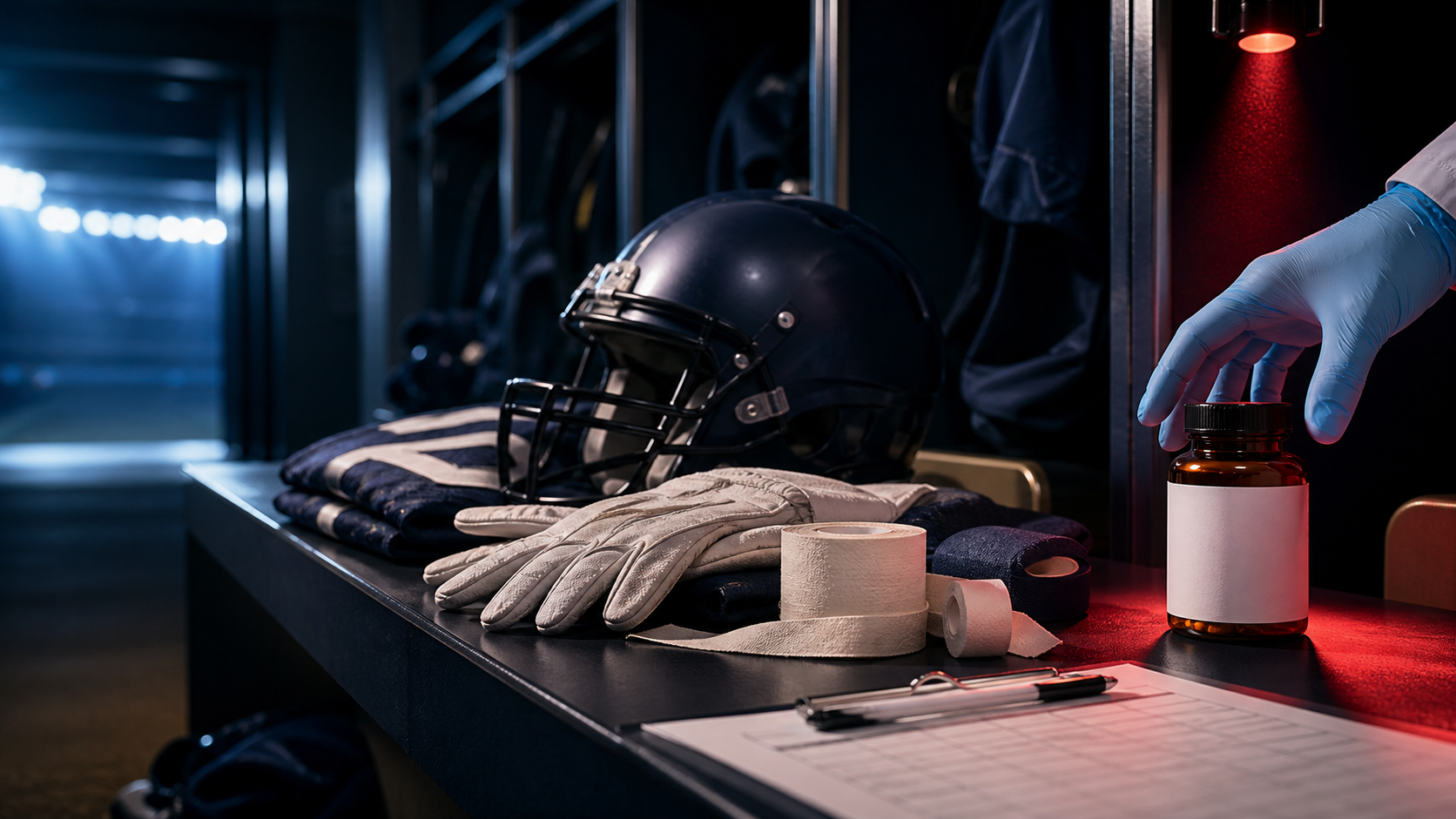
Where college athletes are actually getting this
Potential sources include online research-chemical sellers, inadequately screened clinic services and mislabeled supplements. Each creates different risks.
Research-chemical websites. Products sold "for research use only, not for human consumption" carry no dosing standard, no purity guarantee and no manufacturing oversight. The disclaimer is a legal shield for the seller, not a safety statement.
Wellness and anti-aging clinics operating without real screening. A clinic that will write a peptide or hormone protocol off an online questionnaire, without labs, an examination, and a conversation about what sport you play, has skipped the step that matters most for a competing athlete.
Supplements that are not what the label says. Independent programs such as NSF Certified for Sport or Informed Sport can reduce contamination risk, but certification cannot guarantee safety, effectiveness or freedom from every prohibited substance. Verify the specific product and batch with athletic staff. USADA explains the remaining supplement risks.
The pre-season checklist worth handing to your team
- Nothing goes in without clearing it with the athletic training staff first — oral, injectable, topical, "research use only," or a gift from a teammate.
- A prescription is not a permission slip. For anabolic agents, hormone and metabolic modulators, and peptide hormones, the NCAA medical exception pre-approval has to be granted before you practice or compete.
- Fertility, anti-estrogen and TRT-adjunct medications also require verification. A prescribed fertility medication can still be prohibited. If you and your partner are trying to conceive and you compete in a tested sport, that conversation has to include your compliance staff.
- Third-party certified supplements only. NSF Certified for Sport or Informed Sport. Deer antler velvet and colostrum sit next to IGF-1 on the NCAA page.
- A clean urine test is not the whole exposure. Admissions, group chats and order receipts have driven cases. Assume anything written down is discoverable.
- Parents: ask who is prescribing and what labs were drawn. If the answer is "an online clinic" and there were no labs, that is the answer.
The part most people get backwards
There is a persistent assumption that a hormone clinic is a shortcut for an athlete who wants an edge. In practice it works the other way around, and the reason is the labs.
Treatment decisions here begin with laboratory testing and a physician evaluation. A man whose testosterone is already in range — or elevated, which is the usual finding in someone currently running a cycle — is not a candidate for testosterone replacement, and no amount of wanting it changes the number on the panel. That single requirement removes most of the people who call asking about performance from the pool before anyone gets to a conversation about policy. The rules and the bloodwork happen to point the same direction.
Which is why the useful version of this article is not a warning about clinics. It is a warning about the three doors above — the research-chemical site, the clinic that skips the labs, and the uncertified tub on the shelf.
For adults who are not competing in tested sport and who have symptoms that may reflect an actual deficiency, the path starts with testing and a conversation, not with a vial. You can schedule a consultation with our team, or read what peptide therapy is and is not and the questions worth asking before starting TRT.
And if you are here because your testosterone spikes when your team wins on Sunday afternoon — that is real, it is temporary, and we wrote about it: Can Watching Sports Increase a Man's Testosterone Levels?
Prepared by the NovaGenix Editorial Team.
Medically reviewed by Timothy Mackey, D.O. on September 6, 2026.
Disclosures
NovaGenix does not provide testosterone, hormone, or peptide therapy for athletic performance enhancement. We do not treat athletes seeking to compete in NCAA, NFL, MLB, or any WADA-code-governed sport while using prohibited substances, and we decline these requests. If you compete under any anti-doping code, assume every therapy discussed on this site is prohibited for you unless your compliance staff confirms otherwise, in writing, in advance.
Whether you are a candidate for any therapy is a clinical determination that requires labs and a physician evaluation — which is the reason we do not prescribe on the basis of an online form.
Compounded medications are not FDA-approved and are not reviewed by the FDA for safety or effectiveness before they are dispensed.
This article is general educational information about anti-doping rules and regulatory status. It is not medical advice, not legal advice, and not a substitute for evaluation by a qualified physician. Anti-doping lists and FDA regulatory status change; verify current rules with your compliance staff and the governing body before acting on anything here.
Sources
- NC State WR Teddy Hoffmann suspended for 2026 season after positive PED test — CBS Sports
- A Track Star, Doping Allegations, & The NCAA's Anti-Doping Policy Exposed — LetsRun.com
- 2026-27 NCAA Banned Substances (PDF) — NCAA
- Medical Exceptions for NCAA Banned Substances — NCAA.org
- BPC-157: Experimental Peptide Creates Risk for Athletes — USADA
- FDA Panel Backs 6 Peptides for Compounding — AJMC
- Titans' Nazeeh Johnson says fertility medication led to six-game NFL suspension — CBS Sports
- NFL suspends Saints WR Brock Rechsteiner for the first six games — NBC Sports
- Jurickson Profar gets 162-game PED suspension after appeal resolved — ESPN
- Free-agent outfielder Max Kepler suspended 80 games for PEDs — MLB.com
- Phillies' Johan Rojas suspended 80 games for failed drug test — ESPN



