
Connect with us


.png)

Schedule a Consultation!
Testosterone Replacement Therapy FAQ: Common TRT Questions Answered
Testosterone Replacement Therapy: Common Questions Answered
Medically reviewed by Timothy Mackey, D.O., Medical Director, NovaGenix Health & Wellness · Last reviewed August 2026
Fatigue that doesn't lift with sleep. A libido that's quietly disappeared. Strength and body composition moving in a direction you didn't choose. Men often file these under aging — and sometimes that's exactly what they are. Sometimes they're low testosterone, and sometimes they're something else entirely, which is why the evaluation matters more than the assumption.
Below are the questions patients at our Jupiter, Florida clinic ask most often, answered directly. None of this replaces a medical evaluation, and testosterone therapy is not appropriate for every man.
What is testosterone replacement therapy?
Testosterone replacement therapy (TRT) is a prescription treatment that supplements testosterone in men whose bodies don't produce enough. It's used to treat hypogonadism — clinically low testosterone confirmed by blood testing —alongside symptoms. TRT is not a supplement, a booster, or a performance enhancer. It's a monitored medical therapy.
Treatment at NovaGenix begins with a physical exam and laboratory testing, not a questionnaire. Dr. Mackey reviews your symptoms, medical history, medications and lab results before determining whether treatment is appropriate. Some men who come in expecting testosterone leave with a different diagnosis entirely —thyroid dysfunction, sleep apnea, and depression all produce overlapping symptoms.
Learn more about testosterone replacement therapy at NovaGenix
Is TRT FDA-approved for age-related low testosterone?
FDA labeling has changed. In June 2026, FDA requested removal of the limitation stating that safety and efficacy in age-related hypogonadism had not been established, along with revisions to prostate-related safety information. The current FDA testosterone information explains the requested updates. Check the prescribing information for the specific product rather than relying on an older general statement.
This does not mean that age or symptoms alone establish a need for TRT. The Endocrine Society's July 2026 statement continues to emphasize an accurate diagnosis, repeat morning testing, reversible contributors and individual risk assessment.
What testosterone level is considered low?
The AUA identifies total testosterone below 300 ng/dL as a reasonable cutoff supporting diagnosis. Compatible symptoms and two separate morning measurements are also needed; one result is not a diagnosis. Laboratory methods and reference ranges matter.
Free testosterone can add context in selected cases, such as borderline total testosterone or altered SHBG. LH and FSH help investigate the cause; estradiol testing is guided by clinical findings. These tests are not interchangeable or automatically required for everyone.
See how NovaGenix tests for low testosterone
What are the symptoms of low testosterone?
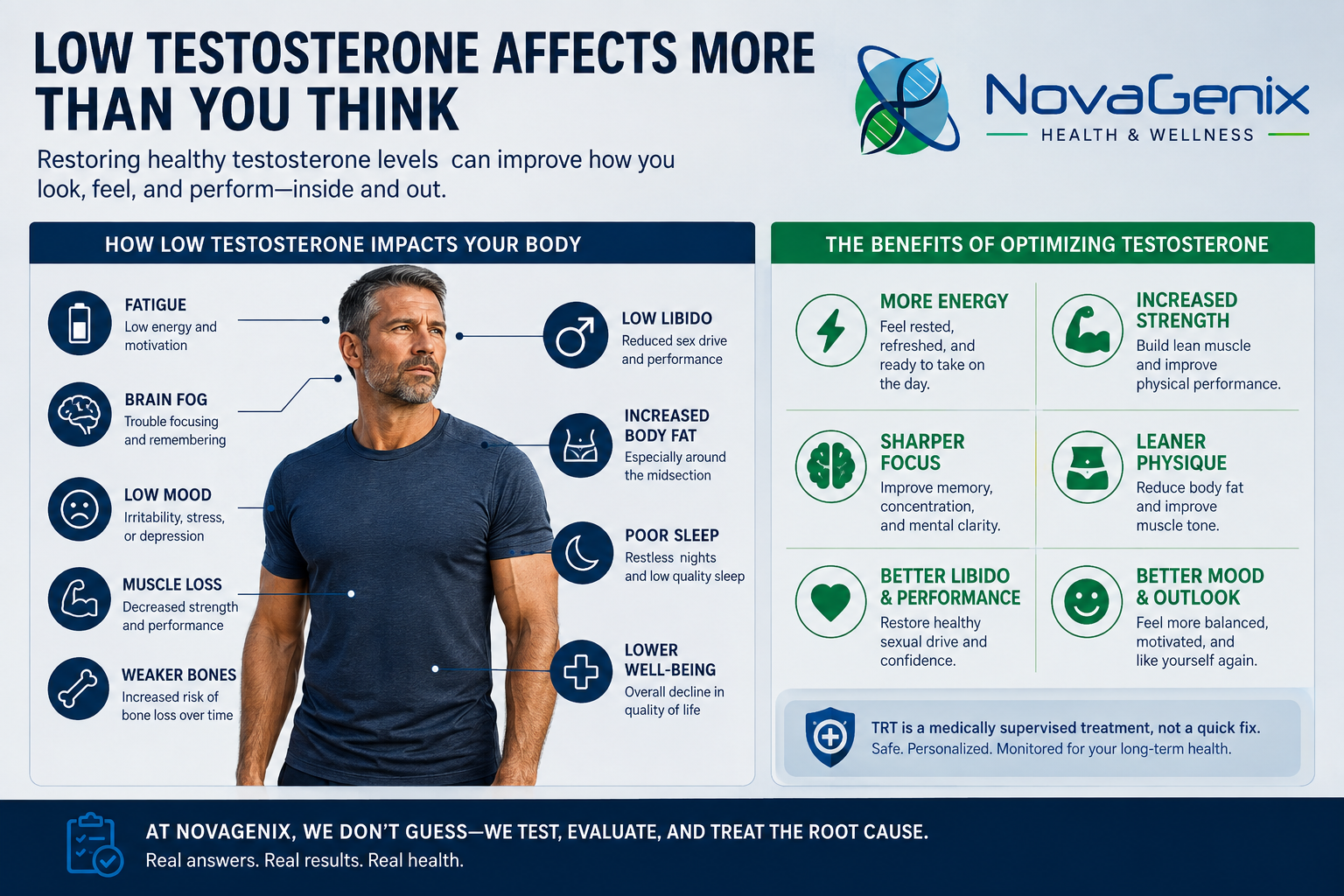
The most commonly reported symptoms are reduced sex drive, erectile difficulty, persistent fatigue, loss of muscle mass and strength, increased body fat aroundthe midsection, irritability or low mood, difficulty concentrating, and poor sleep quality.
Symptoms men most often mention first
● Low libido and reduced spontaneous erections
● Fatigue that rest doesn't resolve
● Loss of strength despite unchanged training
● Increased abdominal fat
● Irritability, low motivation, or depressed mood
● Brain fog and reduced concentration
● Poor sleep quality
● Over time, reduced bone density
None of these are specific to low testosterone. All of them appear in thyroid disease, sleep apnea, depression, anemia, and medication side effects. That's the entire argument for testing rather than guessing.
Read more about low sex drive in men
Who is a candidate for TRT?
Men with symptoms of testosterone deficiency plus confirmed low testosterone on two morning blood tests, and no untreated contraindication. A consultation does not guarantee a prescription — if your labs are normal, or if your symptoms point somewhere else, Dr. Mackey will say so and help you find the right next step.
Am I a candidate for TRT? The full criteria, explained
Who should not take TRT?
Testosterone therapy is generally not appropriate for men with active prostate cancer or male breast cancer, men actively trying to conceive, men with an elevated hematocrit, men with untreated severe obstructive sleep apnea, or men with uncontrolled heart failure. Most of these are reasons to delay rather than permanent exclusions. The Endocrine Society clinical practice guideline is explicit about the required pre-treatment workup.
See the full list of what delays or rules out TRT
How is TRT administered?
Options include injections, topical preparations and other product-specific formulations. Route, schedule, transfer precautions, cost and monitoring differ. No method is best or cheapest for every person; follow the exact prescription and product instructions.
Topical testosterone can transfer through skin contact, including to children and partners. Discuss prevention and household circumstances before selecting it. NovaGenix does not offer testosterone pellets or patches.
What are the potential benefits of TRT?
In appropriately diagnosed men, treatment may improve sexual symptoms, anemia, bone density, lean mass and depressive symptoms. Evidence is less certain for fatigue, cognition, energy and overall quality of life. Individual responses vary.
TRT is not a general weight-loss or performance-enhancing treatment, and changes in lean mass do not guarantee strength gains. Symptoms that do not improve deserve reassessment.
Learn about medically supervised weight management at NovaGenix
What are the risks and side effects of TRT?
Potential adverse effects include increased hematocrit, blood-pressure changes, acne, fluid retention, breast symptoms, reduced testicular volume and suppressed sperm production. Risks vary by person, dose and formulation. Severe untreated sleep apnea and other relevant conditions require assessment before treatment.
Elevated hematocrit requires clinician review and may lead to treatment adjustment or a pause. Do not manage it by changing medication or arranging repeated blood donation without the treating clinician.
TRAVERSE studied testosterone gel in a selected population and found noninferiority for major cardiovascular events. It did not establish heart-disease prevention or eliminate all risk. FDA required broader blood-pressure warnings in 2025. Read the FDA labeling update.
How long does TRT take to work?
Some symptoms may change within weeks, while body-composition or bone effects take longer. There is no reliable promise that every patient will notice improved energy, mood or sexual function by a certain week.
Follow-up should compare symptoms, hormone levels, adherence and adverse effects. If appropriate levels are reached without meaningful benefit, the clinician should reconsider the explanation and treatment plan.
How often do I need bloodwork on TRT?
Testing is needed before treatment and during follow-up, commonly within three to six months and at least annually once stable. The schedule and blood-draw timing depend on the product, clinical response and risks.
- Testosterone measurement helps assess exposure; free testosterone is selected when useful.
- CBC and hematocrit help detect increased red-cell concentration.
- Blood pressure and symptoms are assessed alongside laboratory findings.
- PSA and prostate evaluation are considered when appropriate.
- Estradiol, thyroid, metabolic or other hormone tests are ordered according to clinical findings.
Monitoring helps manage risk but cannot make TRT risk-free. Laboratory testing, including follow-up labs, is billed separately from the TRT program.
Does TRT affect fertility?
Yes. External testosterone can suppress the hormonal signals needed for sperm production. Discuss current or future fertility goals before starting. The AUA/ASRM male infertility guideline advises against exogenous testosterone for men interested in current or future fertility and says evidence is too limited to recommend adding hCG or related drugs to preserve sperm production during TRT.
A specialist may discuss avoiding testosterone, sperm banking or selected alternative treatments. hCG has approved indications for certain male conditions, but adjunctive use during TRT is not a guaranteed fertility-preservation strategy. Enclomiphene is not FDA-approved; describing it simply as off-label can obscure that distinction. Compounded products are not FDA-approved. If you are also comparing peptide claims with TRT, see which peptides can affect testosterone signaling and which act on different hormone pathways.
Recovery after stopping TRT can take months or longer and is not assured on a fixed timetable. Semen testing is needed to assess sperm production; testosterone levels or testicular size cannot establish fertility.
What happens if I stop TRT?
Symptoms may return, and recovery of natural testosterone production varies with the underlying condition and treatment history. Some people remain deficient. There is no universal taper or recovery schedule. Read our guide to coming off TRT.
Discuss stopping with the prescriber so follow-up can address symptoms, hormone levels and fertility when relevant. NovaGenix has no cancellation fee; the clinic requires either 30 days' notice or payment of the current balance for services and medications. Billing arrangements are separate from a medically appropriate stopping plan.
Is TRT safe long-term?
Patient selection and monitoring are important, but long-term safety is not settled for every population, formulation or duration. The Endocrine Society's 2026 statement calls for more long-term evidence, including prostate outcomes.
Periodic review should consider whether benefits continue to outweigh risks. Blood tests alone do not establish that every relevant condition is absent or controlled.
Does NovaGenix offer telehealth for TRT?
Sometimes. Availability depends on the state you live in, applicable telemedicine law, and whether your situation can be appropriately evaluated remotely. The team will explain whether an in-person examination is needed and arrange appropriate laboratory testing.
Contact the office and we'll tell you honestly whether telehealth is appropriate for your situation, or whether you need to come in.
Start with our new patient forms
Does insurance cover TRT?
NovaGenix is a self-pay practice and does not bill insurance. Coverage through other providers depends on the individual plan. Ask the insurer directly about its requirements; payment method alone does not establish care quality.
The $125 initial male hormone panel includes physician lab review or consultation. All laboratory testing is billed separately from the TRT program. Patients may supply their own results for physician review or use the clinic's physician account with Labcorp for affordable lab rates. Confirm medication and visit charges before enrollment.
How do I get started with TRT in Jupiter, Florida?
Call or text NovaGenix at 561-277-8260, or request a consultation online.We'll discuss your symptoms and goals, arrange laboratory testing, and schedule your evaluation with Dr. Mackey.
NovaGenix Health &Wellness
609 N. Hepburn Avenue, Suite 106
Jupiter, Florida 33458
Serving Jupiter, Palm Beach Gardens, Tequesta, Juno Beach, North Palm Beach and Palm Beach County.
Men's hormone therapy · Women's hormone therapy · Medical weight loss · Peptide therapy
About the author

Timothy Mackey, D.O. is the Medical Director of NovaGenix Health & Wellness in Jupiter, Florida. He is a Florida-licensed osteopathic physician (license OS9185, NPI 1730235797) with internal medicine training, United States Army service, and more than two decades in clinical practice. His credentials can be independently verified through the CMS NPI Registry and the Florida Department of Health.
Medical disclaimer: This article is for general educational purposes and does not provide medical advice, diagnosis, or treatment. Individual results vary. Treatment decisions requirean appropriate medical evaluation, and no therapy is suitable for every patient.
Comparing providers? If you are deciding where to receive care, see our guide to choosing a TRT clinic in Palm Beach County, including physician oversight, testing, monitoring, treatment options and pricing questions to ask.
Questions about treatment options?
Speak with NovaGenix about physician-led evaluation, testing, and treatment options in Jupiter, Florida.
Medical disclaimer: This article is for general educational purposes only and is not medical advice, a diagnosis, or a treatment recommendation. Reading it does not create a physician-patient relationship. Always consult a qualified healthcare professional about your individual circumstances, and never delay seeking care because of something you read here. If you are experiencing a medical emergency, call 911. Read our full Medical Disclaimer.

Contact Us
Blood Work Request Form

609 N Hepburn avenue suite 106. Jupiter, Florida 33458

609 N Hepburn avenue suite 106. Jupiter, Florida 33458

561-277-8260

Schedule a Consultation
Learn what you want to know about hormone therapy by scheduling a free consultation.
Contact Us Today609 N Hepburn Ave Ste 106, Jupiter, FL 33458
Monday - Friday: 9:00 am - 5:00 pm | Saturday-Sunday: Closed